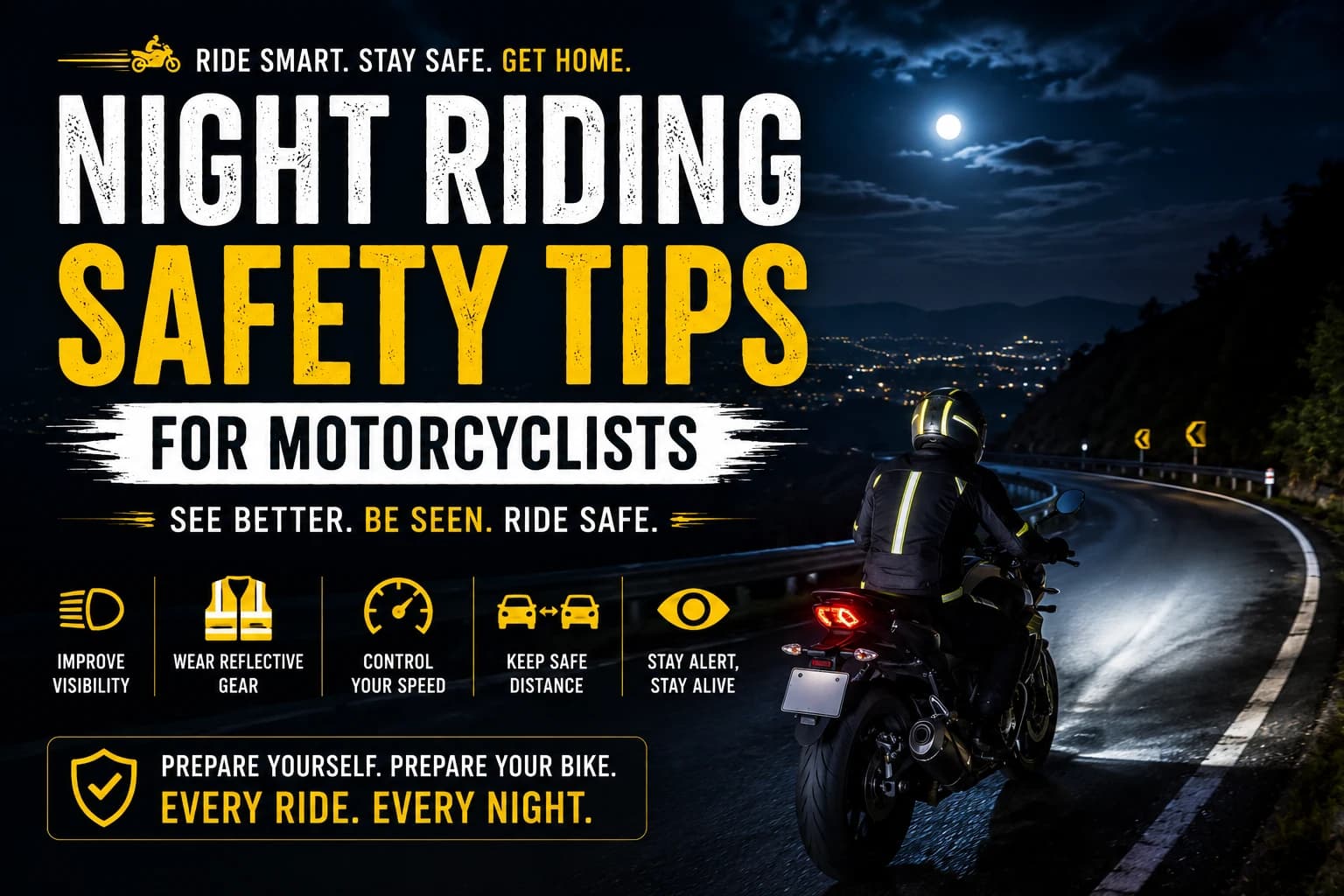
Night Riding Safety Tips for Motorcyclists
Ridivo Team
·22 July 2026
Night Riding Safety Tips for Motorcyclists
Night riding isn't day riding with the lights off — visibility drops, reaction windows shrink, and the hazards that are easy to spot at noon (a pothole, a stray dog, a slow-moving cart) become genuinely dangerous once the sun's down. Most of the risk isn't the darkness itself; it's riders who don't adjust anything about how they ride once it arrives.
This guide covers practical night riding safety tips for motorcyclists — not just what to watch for, but exactly how to change your riding once daylight is gone. Night riding is one of the specific scenarios worth understanding on its own within the broader common causes of motorcycle accidents.
Table of Contents
- Quick Reference: Night Riding Risks
- 1. Make Yourself Visible
- 2. Ride Within Your Headlight Range
- 3. Reduce Your Speed
- 4. Increase Following Distance
- 5. Watch for Wildlife
- 6. Avoid High Beam Misuse
- 7. Stay Alert for Fatigue
- 8. Inspect Your Motorcycle Before Riding
- 9. Keep Your Helmet Visor Clean
- 10. Plan Fuel Stops
- 11. Ride Defensively
- 12. Avoid Riding Alone on Isolated Roads
- Hidden Tips Most Riders Miss
- FAQs
Quick Reference: Night Riding Risks
| Risk | Why It's Worse at Night | Quick Fix |
|---|---|---|
| Low visibility | Drivers and riders both see less, later | Reflective gear, auxiliary lights, clean visor |
| Outriding your headlight | Stopping distance exceeds what you can see | Match speed to what your headlight actually shows |
| Hazards spotted too late | Potholes, breakers, animals blend into the dark | Slow down, especially into unlit curves |
| Shorter reaction windows | Everyone needs more time to react at night | Increase following distance |
| Wildlife crossings | Most active at dawn, dusk, and late evening | Slow down on known crossing stretches |
| Glare from high beams | Blinds you for several seconds at a time | Dip your beam, look to the road's left edge |
| Fatigue | Night riding accelerates eye and mental fatigue | Break every 90–120 minutes, know when to stop |
| Closed fuel stations | Rural pumps often shut early | Plan fuel stops before you need them |
1. Make Yourself Visible
Being seen matters more at night than almost anything else on this list — a driver who spots you two seconds earlier has two more seconds to react.
- Wear reflective riding gear or a jacket with reflective panels rather than an all-dark one.
- Auxiliary lights genuinely help — they widen your visible footprint to other vehicles, not just your own view of the road.
- Keep your helmet visor clean; grime and scratches scatter oncoming light and make you harder to judge distance-wise for other drivers too.
- If you're building out your night-riding kit from scratch, our essential motorcycle riding gear guide, best riding jackets for Indian weather, and best riding gloves roundups are good starting points, along with best budget touring accessories for auxiliary lighting and reflective add-ons.
2. Ride Within Your Headlight Range
This is one of the biggest mistakes riders make at night: riding at a speed where your stopping distance is longer than what your headlight actually illuminates.
- Never outride your headlights — if you can't stop within the distance you can see, you're going too fast for the conditions.
- Low beam has a shorter, wider spread; high beam reaches further but narrower. Know which one you're actually using and ride to match it.
- On unfamiliar roads, assume your headlight range is your real speed limit, regardless of the posted one.
3. Reduce Your Speed
Everything that's easy to spot in daylight — animals, broken road surfaces, pedestrians, unmarked speed breakers — becomes much harder to see at night, and speed is the one variable fully in your control.
- Slow down noticeably compared to your daytime pace, especially on rural and unfamiliar roads.
- Ease off further before any unlit curve — potholes and gravel patches are far harder to spot mid-turn in the dark.
- Treat every unmarked stretch as though a speed breaker or pothole could be just ahead, because at night, it often is.
4. Increase Following Distance
You need more reaction time at night, plain and simple — the same gap that feels safe in daylight isn't enough once visibility drops.
- Widen your following distance noticeably behind any vehicle ahead of you.
- Watch brake lights closely; they're often your earliest warning of a hazard you haven't seen yet yourself.
- Give yourself extra space specifically around unlit intersections and junctions, where a vehicle can appear with very little warning.
5. Watch for Wildlife
Wildlife crossings are a real and often underestimated night-riding risk, especially on routes that pass through forest or rural stretches — roads like Nandi Hills Road, Kanakapura Road, BR Hills, MM Hills, Agumbe, and Muthathi all see regular wildlife activity after dark.
- Slow down noticeably on any route known for forest or rural stretches, particularly at dawn, dusk, and late evening, when animals are most active.
- Scan the road edges, not just the road ahead — animals often approach from the shoulder rather than crossing head-on.
- If you're riding in a group through these stretches, agree on hand signals for a sudden hazard ahead of time — a wildlife sighting needs a faster warning than words can carry back through a convoy.
6. Avoid High Beam Misuse
High beams help you see further, but misused, they blind oncoming riders and drivers just as effectively as they help you.
- Dip your beam well before an oncoming vehicle reaches you, not at the last second.
- If an oncoming vehicle keeps its high beam on, don't stare into it — shift your gaze toward the left edge of the road instead and use your peripheral vision to hold your line until it passes.
- Reserve high beam for genuinely unlit, empty stretches, and drop it the moment another vehicle appears in either direction.
7. Stay Alert for Fatigue
Fatigue hits harder and faster at night — your body's natural rhythm is already pulling toward rest, and riding through that instinct is genuinely risky.
- Watch for micro-sleeps and slowed reaction time, both classic signs that you've pushed past your limit.
- Coffee helps briefly but isn't a substitute for an actual break — treat it as a supplement, not a fix.
- Know when to stop. If you're touring long distances after dark, our motorcycle touring mistakes first-time riders should avoid guide covers this exact trap in more depth.
8. Inspect Your Motorcycle Before Riding
A pre-ride check matters every time, but a failure at night — a dead taillight, a weak headlight — is far more dangerous than the same issue in daylight.
- Check your lights, brake lights, and indicators are all working before you leave, not just your headlight.
- Confirm tyre condition and pressure; grip matters even more when hazards are harder to see coming.
- Check your chain tension and lubrication, especially before any longer night ride.
- Our motorcycle maintenance checklist covers this in full and is worth running through before any ride after dark.
9. Keep Your Helmet Visor Clean
A scratched or dirty visor is a bigger problem at night than most riders realize — light scatters differently once the sun's down.
- Scratches on the visor become significantly worse at night, scattering oncoming headlights into a blur.
- Rain increases glare further, so a visor that's merely annoying in the day can become genuinely dangerous at night in wet weather. If you're riding at night in the monsoon specifically, our motorcycle safety tips for monsoon guide covers that combination in more depth.
- If your current helmet's visor is past its best, it may be time to look at your options — our guides to choosing the right motorcycle helmet, comparing full-face vs modular vs open-face helmets, and best budget helmets under ₹5,000 all cover visor quality as part of the decision.
10. Plan Fuel Stops
Many rural petrol stations close earlier than you'd expect, and running low on fuel on an unlit stretch is not a situation you want to discover the hard way.
- Plan your fuel stops in advance rather than riding until the tank nudges reserve.
- On rural or highway night rides, top up earlier than you would during the day — you can't always count on the next pump being open.
- Build this into a broader plan if you're touring — our essential motorcycle touring checklist covers fuel planning alongside the rest of your prep.
11. Ride Defensively
Defensive riding matters at all hours, but at night, the margin for someone else's mistake shrinks considerably.
- Assume other vehicles haven't seen you, especially at unlit intersections and junctions.
- Actively avoid sitting in another vehicle's blind spot for longer than necessary.
- Always keep an escape route in mind — a clear path to your side or ahead in case a hazard appears without warning.
12. Avoid Riding Alone on Isolated Roads
Isolated roads at night carry a different kind of risk — not just the riding conditions, but what happens if something goes wrong with no one around.
- Be especially cautious on remote ghats and forest roads after dark, where help can be a long way off.
- Share your live location with someone before setting out on an isolated night ride — this is exactly the kind of situation Ridivo's live location sharing is built for, so someone always knows roughly where you are.
- Carry emergency contacts and make sure your phone is reachable, even in low-signal stretches.
- If you're riding with others, our group riding safety guide covers how to keep a convoy together specifically on the kind of roads where isolation is the real risk, not just the dark.
Hidden Tips Most Riders Miss
A few details that make a bigger difference than they get credit for:
- Keep the inside of your visor spotless too — smudges on the inner surface create halos around oncoming headlights that are easy to mistake for glare from outside.
- Reduce speed before an unlit curve, not mid-turn — potholes and gravel patches are far harder to spot once you're already leaning into the bend.
- Avoid tinted or dark visors once the sun sets; carry a clear visor if there's any chance you'll still be riding after dark.
- Keep your phone charged and download offline maps before leaving urban areas — signal on rural night routes is far less reliable than during the day.
- Take a short break every 90–120 minutes on longer night rides. It costs a few minutes and buys back a meaningful amount of concentration.
FAQs
Is it safe to ride a motorcycle at night? Yes, with adjusted technique — reduced speed, increased following distance, proper visibility gear, and extra caution around wildlife and fatigue. The risk comes from riding at night exactly as you would during the day.
What's the biggest mistake riders make at night? Outriding their headlights — travelling at a speed where their stopping distance exceeds what they can actually see, leaving no margin for a sudden hazard.
How can I improve my visibility at night? Reflective gear, auxiliary lights, and a clean, unscratched visor make the biggest difference. A bright jacket also helps drivers judge your position and speed more accurately.
Should I use high beam or low beam on unlit roads? Use high beam on empty, genuinely unlit stretches, but dip to low beam well before any oncoming vehicle to avoid blinding its driver — and expect the same courtesy in return.
How do I deal with oncoming high beam glare? Don't stare directly into it. Shift your gaze toward the left edge of the road and use your peripheral vision to hold your line until the vehicle passes.
How often should I take breaks on a long night ride? Roughly every 90–120 minutes, or sooner if you notice any sign of fatigue — micro-sleeps and slowed reaction time are the clearest signals it's time to stop.
Are there specific roads where wildlife crossings are more common at night? Forest and rural stretches like Nandi Hills Road, Kanakapura Road, BR Hills, MM Hills, Agumbe, and Muthathi all see regular wildlife activity, particularly around dawn, dusk, and late evening.
Conclusion
Night riding isn't inherently more dangerous than day riding — it's just less forgiving of the same mistakes. Slow down, make yourself seen, keep your gear and motorcycle in proper shape, and treat isolation and fatigue as seriously as any hazard on the road itself.
Ride smarter with your crew
Live tracking, SOS alerts, route planning — built for Indian motorcycle and cycling groups.
Join the waitlist