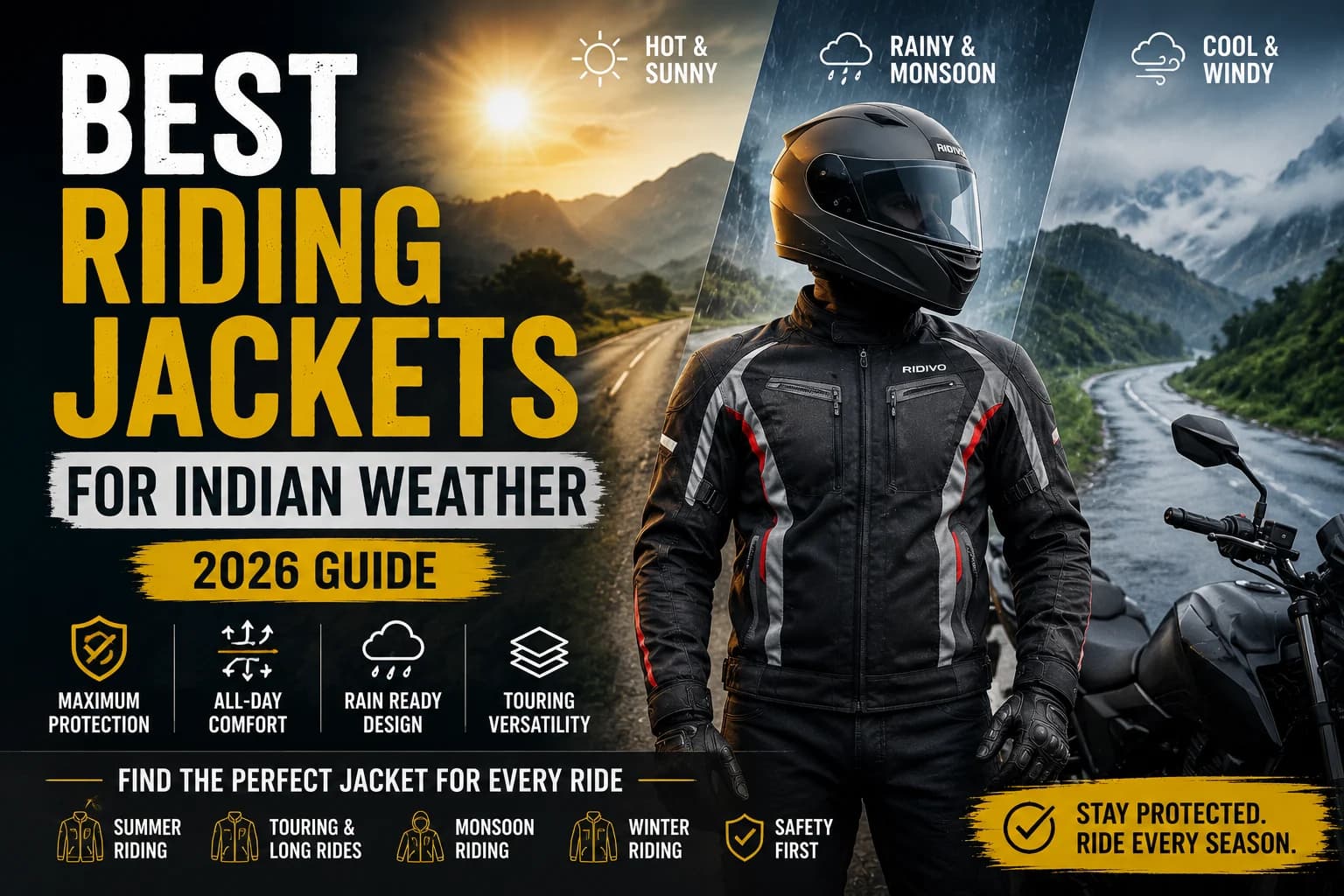
Best Riding Jackets for Indian Weather (2026 Guide)
Ridivo Team
·6 July 2026
Best Riding Jackets for Indian Weather (2026 Guide)
You leave home in 34°C heat, hit a surprise shower an hour later, and you're back to sun by the time you stop for chai. That's not a bad day — that's just riding in India. A jacket that only works in one of those conditions is a jacket you'll stop wearing, and the moment you stop wearing it, it stops protecting you.
Table of Contents
- Why Riding Jackets Matter
- What Makes a Jacket Work for Indian Weather
- Types of Riding Jackets
- Which Jacket Type Fits Your Ride
- Features Worth Checking Before You Buy
- Common Mistakes Riders Make
- Riding Jackets Through the Indian Seasons
- FAQs
Why Riding Jackets Matter
A jacket isn't there to look the part. It's the layer between your skin and the road if things go wrong, and the layer between you and heatstroke or a chill on a long haul either way. Good riding gear covers four jobs at once:
- Abrasion protection — a slide in denim ends very differently than a slide in a textile jacket.
- Impact protection — CE-rated armor at the shoulders and elbows absorbs what your bones otherwise would.
- Weather resistance — keeping rain off you and heat off your back so fatigue doesn't creep in.
- Visibility — reflective panels matter most exactly when you don't expect to need them, like a sudden evening downpour.
Think of it as safety gear first. The fact that it also looks good is a bonus, not the point.
What Makes a Jacket Work for Indian Weather
This is where a lot of imported gear reviews miss the mark — jackets designed for European or American riding assume mild, dry summers. India doesn't offer that.
A jacket built for Indian conditions needs:
- Real airflow, not just a couple of decorative vents — mesh panels or large perforated zones front and back.
- A removable rain liner, so the same jacket handles a dry highway stretch and a sudden Ghats downpour.
- A removable thermal liner for early morning starts or hill routes, without needing a separate winter jacket.
- Lightweight construction that doesn't turn into a sauna the second you're stuck at a signal.
- Quick-dry fabric, because monsoon gear that stays soggy for hours is gear you'll avoid wearing next time.
Riders who build topical authority around gear tend to focus on specs. What actually matters on Indian roads is how the jacket behaves across a single day's temperature and weather swing — because that swing is normal, not an edge case.
Types of Riding Jackets
Mesh Riding Jackets
Best for city traffic and summer rides. Perforated panels let air move through even at low speeds, which matters more in stop-start Bangalore traffic than on an open highway.
- Pros: excellent airflow, lightweight, comfortable for daily commuting
- Cons: minimal rain protection on their own — you'll want a compatible rain layer for the monsoon
Touring Jackets
Built for highway distance and Karnataka's touring routes — think Coorg, Chikmagalur, or a Mysore-Ooty run. These usually combine a shell with removable liners so one jacket adapts across a multi-day trip.
- Pros: versatile across weather, better protection coverage, made for long saddle time
- Cons: can feel warm in slow city traffic without good vents
Waterproof / Monsoon Jackets
Purpose-built for the rainy months. Look at how the seams are sealed, not just whether the fabric claims to be waterproof — stitched seams without taping will leak eventually.
- Focus on a genuine rain shell rather than just water-resistant coating
- Check how quickly the fabric dries out — sitting in a damp jacket all day adds up to real fatigue
Which Jacket Type Fits Your Ride
| Use case | Best jacket type | Why |
|---|---|---|
| Daily Bangalore commute | Mesh jacket | Airflow matters more than anything else in traffic |
| Highway touring (Coorg, Chikmagalur, Sakleshpur) | Touring jacket with liners | Handles temperature swings across a full day's ride |
| Monsoon rides | Waterproof / monsoon jacket | Sealed seams and quick-dry fabric over style |
| Winter highway starts | Touring jacket + thermal liner | Wind cut at speed is the real problem, not just cold |
| First jacket on a tight budget | Mesh jacket with removable armor | Covers the basics without overspending before you know your riding style |
Features Worth Checking Before You Buy
Whatever style you pick, these matter more than brand or color:
- CE-rated armor at shoulders and elbows, and ideally a back protector slot
- Ventilation zippers that actually open into mesh, not just decorative flaps
- Reflective panels, especially if you ride early mornings or after dark
- A proper fit — not too loose (armor shifts out of place) and not so tight it restricts movement
- A removable liner system rather than buying separate jackets for separate seasons
Tip: Try the jacket sitting on a bike, not just standing in a shop. Riding posture changes where a jacket pulls or bunches.
Common Mistakes Riders Make
- Buying oversized "for comfort" — a loose jacket lets armor slide away from the joints it's meant to protect.
- Ignoring ventilation because a jacket "looks tough" — you'll stop wearing it by May.
- Choosing style over protection — a fashion jacket with no armor isn't riding gear, no matter how it's marketed.
- Skipping the liner check — assuming a jacket is monsoon-ready without confirming the rain layer is genuinely waterproof.
- Riding gear-less "just for a short ride" — most incidents happen close to home, not on the highway.
Riding Jackets Through the Indian Seasons
Summer Riding
Prioritize mesh construction, lighter colors that reflect heat, and pair the jacket with proper hydration — a great jacket doesn't fix a dehydrated rider.
Monsoon Riding
A genuine waterproof shell and a fabric that dries fast between showers matter more than anything else. Keep phone and wallet in a separate waterproof pouch regardless — no jacket pocket is fully sealed.
Winter Highway Riding
Wind cuts through fabric fast at highway speed even when the air temperature seems mild. A thermal liner and a jacket with a snug collar make an early-morning ghat start far more manageable.
If you're heading out with a group across one of these seasonal swings, it helps to have everyone declare their gear before the ride starts — Ridivo's pre-ride checklist lets a ride captain confirm who's carrying rain gear and who isn't, before the group is stuck deciding mid-route.
FAQs
Are riding jackets necessary in city traffic? Yes. Most crashes happen at low speed, close to home — not on the highway. A jacket protects you in a signal-to-signal commute just as much as on a long tour.
Which jacket is best for Indian summers? A mesh jacket with removable CE armor. It gives you airflow for traffic and heat, while still covering the basics if you go down.
Can mesh jackets protect riders properly? Yes, as long as the armor is CE-rated and fitted correctly. Mesh refers to the outer fabric's ventilation, not a reduction in the protective layer underneath.
Are waterproof jackets good for touring? They work well if they also breathe — a fully sealed jacket with no ventilation gets uncomfortable fast on a multi-hour ride. Look for a removable rain liner over a jacket that's waterproof but airtight all the time.
How much should beginners spend on a riding jacket? Spend enough to guarantee real CE armor and decent ventilation — those two matter more than brand name. It's fine to start simple and upgrade to a dedicated touring jacket once you know how and where you ride most.
Ride smarter with your crew
Live tracking, SOS alerts, route planning — built for Indian motorcycle and cycling groups.
Join the waitlist