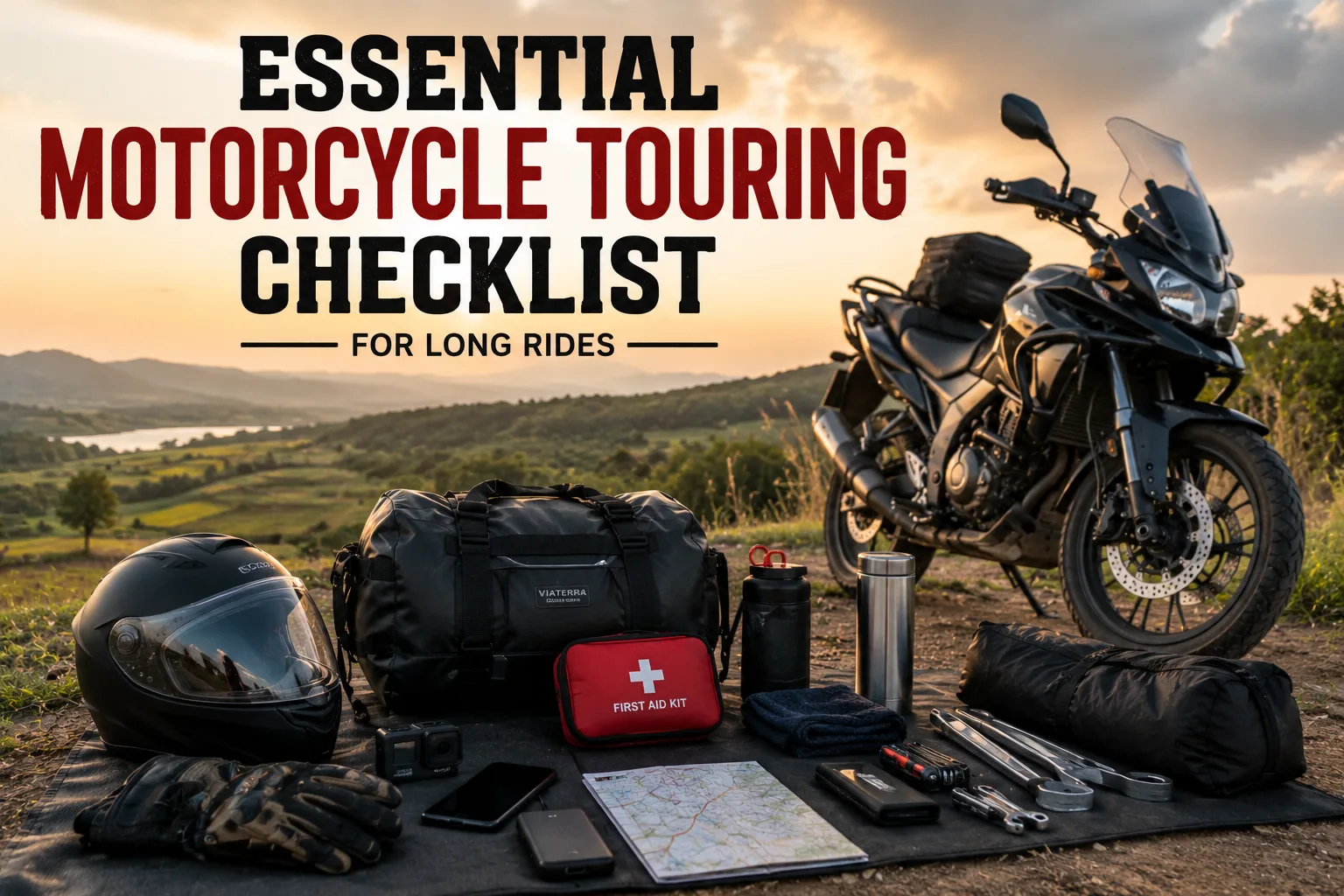
Essential Motorcycle Touring Checklist for Long Rides
Ridivo Team
·20 June 2026
Essential Motorcycle Touring Checklist for Long Rides
Two hundred kilometres in, a bolt rattles loose, the sky opens up, and you realise your rain gear is sitting on your bed at home. Every rider has a version of this story. The difference between a good day and a stranded one is almost never skill — it's what you packed before you left.
This motorcycle touring checklist covers everything that earns its place in your luggage: riding gear, hydration, rain prep, navigation, first aid, and the small kits that get you moving again when something goes wrong. Run through it before every long ride.
Table of contents
- The core touring checklist at a glance
- Riding gear
- Hydration
- Rain prep
- Navigation
- Power banks
- Emergency kits
- First aid
- Tyre puncture kits
- Documents
- FAQ
The core touring checklist at a glance
Short on time? This is the non-negotiable list. If everything below is packed, you're ready to roll.
- Riding gear: helmet, riding jacket, riding gloves, riding boots, knee guards
- Hydration: water (bottle or hydration pack), electrolytes
- Rain prep: rain suit, waterproof gloves, dry bag
- Navigation: phone mount, offline maps downloaded
- Power: power bank, charging cables
- Emergency kit: basic toolkit, tow strap, zip ties, duct tape
- First aid: compact kit with antiseptic, bandages, painkillers
- Puncture kit: plug kit, mini compressor or CO2 inflator
- Documents: licence, RC, insurance, PUC, ID, cash
Tip: Pack by category, not by panic. A small pouch each for tools, first aid, and documents means you can find anything in seconds on a roadside.
Riding gear
Your riding gear is the only thing between you and the tarmac. Treat it as the foundation of the whole kit, not an afterthought.
Helmet. A well-fitted, certified full-face helmet. Clean the visor before you leave — a smeared visor at dusk is genuinely dangerous.
Riding jackets. A proper riding jacket with CE armour at the shoulders, elbows, and back does the heavy lifting in a slide. For long tours, look for a jacket with airflow vents and a removable thermal liner so it works across a hot plain and a cold ghat in the same day.
Riding gloves. Don't ride a long day in fashion gloves. Proper riding gloves with knuckle protection and a secure wrist strap save your hands in the most common type of fall — the one where you instinctively put a palm down. Carry a waterproof pair if rain is likely.
Boots and knee guards. Ankle-covering riding boots and knee guards round out the kit. Sturdy footwear matters more than people think on gravel and loose ghat shoulders.
Good riding gear is the bike riding kit you hope never gets tested. Buy the best you can afford and it pays for itself the first time you need it.
Hydration
Dehydration sneaks up on riders. You're concentrating, the wind is drying you out, and you don't feel thirsty until you're already tired and slow to react.
- Carry at least a litre of water you can reach without stopping — a hydration pack is ideal.
- Add electrolytes for rides over a couple of hours, especially in summer.
- Sip at every fuel and breakfast stop rather than chugging once at lunch.
Fatigue from dehydration feels exactly like ordinary tiredness, which is what makes it risky. Drink before you're thirsty.
Rain prep
In the Western Ghats, a clear morning can turn into a downpour by noon. Rain prep is not optional on a long ride through Karnataka's hills.
- A two-piece rain suit that actually fits over your riding gear
- Waterproof gloves or covers
- A dry bag (or bin liners inside your luggage) to keep clothes and electronics dry
- Anti-fog treatment or a pinlock visor insert for the helmet
When the rain hits, ease off the throttle, lengthen your following distance, and brake earlier and gentler. Painted road markings and metal surfaces get especially slippery.
Navigation
A phone clamped to the handlebar is fine until you lose signal in a ghat or a forest stretch — which is exactly where you most need directions.
- A solid phone mount that won't vibrate loose
- Offline maps downloaded for the whole route before you leave
- A rough route plan shared with the group so everyone knows the waypoints
This is where coordinating a group ride gets easier with the right tool. Ridivo lets you build a ride with waypoints and pitstops, download offline maps for low-signal sections, and share live location so every rider sees each other on the map in real time. When the group splits at a junction, nobody's left guessing which way the front went.
Power banks
Navigation, live tracking, and your camera all drain a phone fast — and a dead phone on a remote road is a real problem.
- A power bank with enough capacity for at least two full phone charges
- The right cables (and a spare), kept in a dry pocket
- A USB charging point wired to the bike for longer tours, if you can
Charge everything the night before. A power bank you forgot to top up is just dead weight.
Emergency kits
This is the "get me moving again" bag. You won't use it most rides, and you'll be very glad of it the one time you do.
- A basic toolkit matched to your bike's fasteners
- Spare clutch and brake levers for ghat rides
- Zip ties, duct tape, and a length of wire for quick fixes
- A tow strap
- A small torch or headlamp
Featured-snippet target — what goes in a motorcycle emergency kit: A basic motorcycle emergency kit holds a toolkit, a tyre puncture repair kit with an inflator, a tow strap, zip ties, duct tape, spare levers, and a small torch. It covers the most common roadside fixes — a flat, a snapped lever, or a loose part — well enough to get you to the next town.
First aid
A compact first-aid kit belongs on every tour, even short ones. Keep it small and reachable.
- Antiseptic wipes and a small bottle of antiseptic
- Assorted bandages and gauze
- Painkillers and any personal medication
- A roll of medical tape and a pair of gloves
On a group ride, it helps when at least one rider carries a proper kit and knows the basics. If someone goes down, Ridivo's skill-aware SOS routes the alert to the nearest rider with first-aid know-how and texts your emergency contacts — so help reaches you from the person best placed to give it.
Tyre puncture kits
A flat in the middle of nowhere ends a ride unless you can fix it yourself. For tubeless tyres, a puncture kit is one of the most valuable bike riding accessories you can carry.
- A tubeless plug kit (reamer, plugs, insertion tool)
- A mini air compressor or CO2 inflators to re-inflate
- A pressure gauge
Practice plugging a tyre once at home before you ever need to do it on a highway shoulder. The first attempt under pressure shouldn't be the real one.
Documents
Lose your documents and a routine police check or a hospital visit becomes a headache. Carry them, and carry backups.
- Driving licence
- Registration certificate (RC)
- Valid insurance
- PUC certificate
- A government photo ID
- Some cash for tolls and rural stops where UPI is patchy
Keep physical copies in a waterproof pouch and digital copies on your phone (the mParivahan / DigiLocker route works for verification in India). Photos of each document in your phone gallery are a cheap, useful backup.
FAQ
What should be on a basic motorcycle touring checklist? Riding gear (helmet, jacket, gloves, boots), water and electrolytes, rain gear, a phone mount with offline maps, a power bank, a basic toolkit, a first-aid kit, a tyre puncture kit, and your documents. Everything else is a comfort add-on.
What riding gear do I actually need for a long ride? At minimum: a certified full-face helmet, an armoured riding jacket, proper riding gloves, ankle-covering boots, and knee guards. For touring, choose a jacket with vents and a removable liner so it works in both heat and ghat cold.
Are riding gloves really necessary for short rides? Yes. The most common fall is a low-speed one where you instinctively put a hand down. Riding gloves with knuckle protection protect your hands in exactly that scenario, no matter how short the ride.
What's the best way to carry water on a motorcycle tour? A hydration pack you can sip from while riding is ideal, since it keeps you drinking steadily instead of waiting for stops. A bottle in an accessible bag works too — just drink at every pitstop rather than once at lunch.
Do I need a puncture kit if my tyres are tubeless? Especially if they're tubeless. A plug kit plus a mini compressor lets you repair most punctures by the roadside and get to the next town. Practice once at home so the first real attempt isn't on a busy highway.
Ride smarter with your crew
Live tracking, SOS alerts, route planning — built for Indian motorcycle and cycling groups.
Join the waitlist