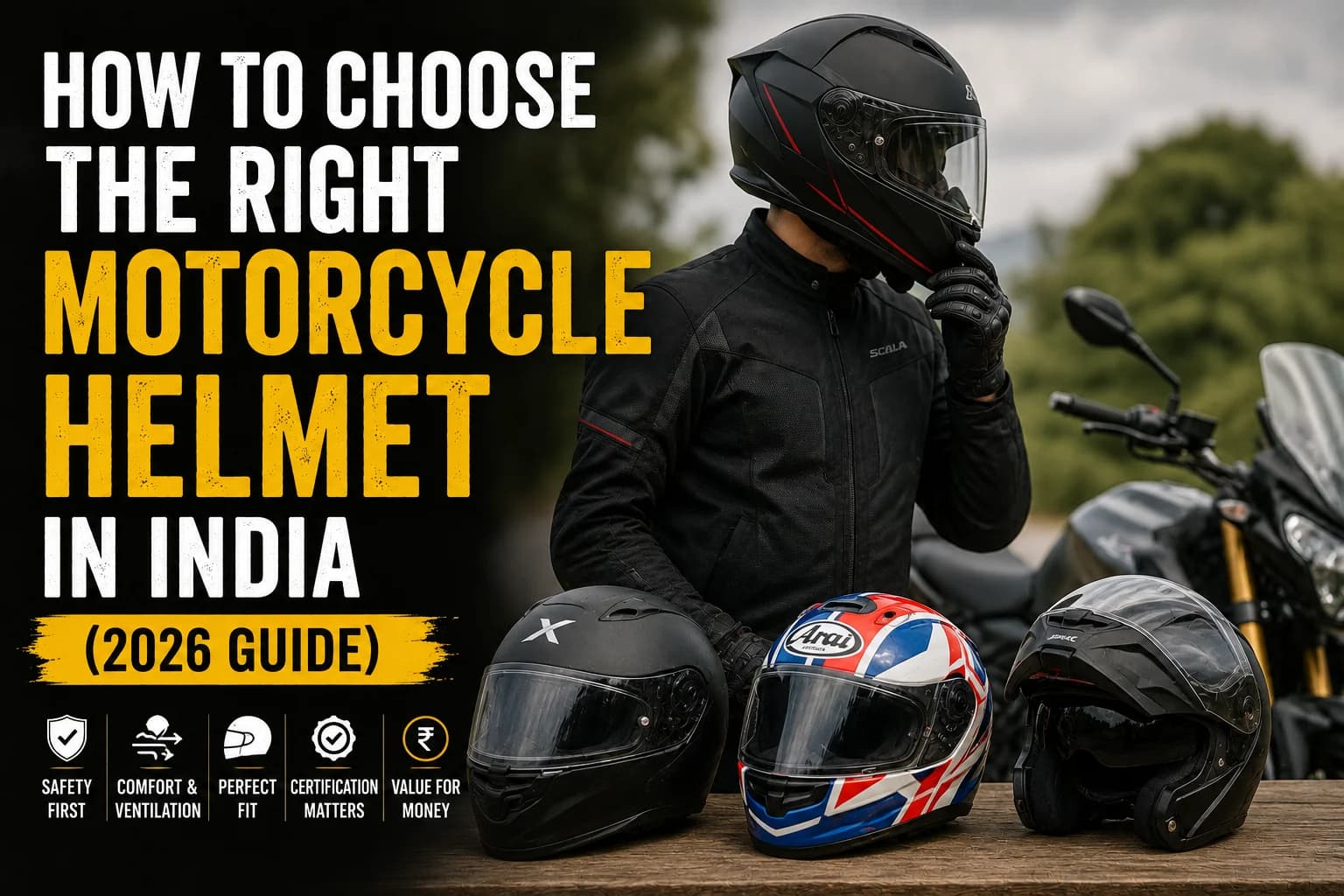
How to Choose the Right Motorcycle Helmet in India (2026 Guide)
Ridivo Team
·20 June 2026
How to Choose the Right Motorcycle Helmet in India (2026 Guide)
Of all the gear a rider buys, the helmet is the one that matters most and the one most people pick worst — chosen for looks, for price, or for the sticker that "looks safe." Your helmet is the single piece of equipment standing between your head and the road, and in 2026 there's no excuse for getting it wrong.
This guide walks through everything that actually matters when choosing the best motorcycle helmet in India: the certifications that count, the helmet types, how to get the fit right, and what to spend. Read it once and you'll never buy a helmet on looks alone again.
Table of contents
- Why helmet quality matters
- Helmet safety certifications
- Full face vs modular vs open face
- Getting the fit right
- Ventilation and comfort
- Weight considerations
- Touring vs city helmets
- Budget recommendations
- Helmet maintenance
- FAQ
- Conclusion
Why helmet quality matters
A helmet's job is to absorb and spread the energy of an impact so your skull and brain don't have to. A cheap, uncertified shell can crack or transmit that force straight through — which is why "any helmet" is not the same as "a safe helmet."
Two things separate a quality helmet from a novelty one: a certified energy-absorbing liner (the EPS foam inside, not the outer shell) and a retention system that actually holds the helmet on your head in a crash. Both are tested by certification standards — which is exactly why those stickers matter so much.
Helmet safety certifications
This is the part most riders get wrong. Here's what the major certifications mean for an Indian rider in 2026.
| Standard | What it is | Status in India |
|---|---|---|
| ISI (BIS, IS 4151) | India's own standard, governed by the Bureau of Indian Standards | Legally mandatory — only ISI-marked helmets are recognised road headgear |
| ECE 22.06 | Current European standard; the global benchmark | Not legally valid alone in India, but the gold standard for protection |
| DOT (FMVSS 218) | US standard, manufacturer self-certified | Basic; fake DOT stickers are common, so treat it with caution |
| SNELL | Strict independent US standard | Voluntary, respected for racing and track use |
| SHARP | UK government 5-star rating program | A useful real-world rating to cross-check |
Featured-snippet target — which helmet certification do I need in India? In India, ISI (BIS, IS 4151) certification is legally mandatory — only an ISI-marked helmet is recognised as legal protective headgear. For the best protection, choose a helmet that carries both ISI and ECE 22.06: ISI for legal compliance and ECE 22.06 for the most advanced crash testing, including rotational-impact protection.
The key 2026 takeaway: ISI is the law, ECE 22.06 is the gold standard, and ISI + ECE 22.06 together is ideal. ECE 22.06 (which replaced the older 22.05) added rotational-force testing, which matters because twisting forces in a slide are a major cause of brain injury that older linear-impact tests don't fully capture.
Note: Helmet rules, fines, and standards can change and vary by state. Treat this as general guidance and check the current rules before relying on any specific figure.
Full face vs modular vs open face
The three main types, and who each suits:
- Full face — one solid piece with a fixed chin bar. The safest option, since it protects your chin and face, and the best choice for touring and highway speeds. If protection is your priority, this is the answer. (Looking for a full face helmet in India is the right instinct.)
- Modular (flip-up) — a full-face shape with a chin bar that flips up. Convenient for touring riders who want to talk, drink, or flip up at a stop without removing the helmet. Slightly heavier and marginally less protective than a true full face, because of the hinge.
- Open face (3/4) — covers the top, back, and sides but leaves your face exposed. Cooler and popular for short city commutes and scooters, but offers no chin protection. A fine city choice, a poor touring one.
For anything beyond a slow city commute, a full face (or a quality modular) is the sensible call.
Getting the fit right
The safest helmet in the world won't protect you if it doesn't fit. A loose helmet can shift or come off in a crash; a too-tight one becomes unbearable within an hour.
- It should be snug, not tight. The helmet should grip your cheeks and forehead firmly with no pressure points.
- Check for movement. With the strap done up, try to rotate the helmet — your skin should move with it, not slide underneath.
- Do the roll-off test. Tip your head forward and try to push the helmet off from the back. A correctly sized helmet won't roll off.
- Wear it for 15–20 minutes in the shop. Pressure points that are mild at first become painful on a long ride.
- Know your shape. Heads are round, intermediate-oval, or long-oval. The right brand for your head shape matters as much as the size number.
Fit varies between brands, so always try before you buy where you can.
Ventilation and comfort
In Indian heat, ventilation isn't a luxury — it's what keeps you alert. Look for:
- Proper intake and exhaust vents that actually channel air across your head, not just decorative slots.
- Moisture-wicking, removable liners you can pull out and wash. A washable liner is a long-term hygiene must.
- An anti-fog visor or a Pinlock-ready visor for monsoon and early-morning rides.
- A clear, scratch-resistant visor with easy operation, plus an internal sun visor on touring lids if you can stretch to it.
A well-ventilated helmet you'll happily wear all day is safer than a stuffy one you keep taking off.
Weight considerations
Helmet weight is comfort and safety combined. A heavy helmet strains your neck over a long ride and adds rotational load in a crash.
- Full-face road helmets typically land around 1,400–1,600 g.
- Lighter shells (fibreglass or carbon composite) cost more but pay off on long tours and reduce neck fatigue.
- Balance matters as much as raw weight — a well-balanced 1,500 g helmet can feel lighter than a poorly balanced lighter one.
If you tour long distances, spending up for a lighter, better-balanced shell is one of the more worthwhile upgrades.
Touring vs city helmets
- City / commuter helmets prioritise ventilation, light weight, and easy on-off. Open-face or a basic full-face ISI helmet is fine for short, low-speed urban riding.
- Touring helmets prioritise long-haul comfort, noise reduction, a wider field of view, a sun visor, and Pinlock-ready anti-fog visors. A full-face or modular helmet with ISI + ECE 22.06 is the touring sweet spot.
If you ride both, buy for the harder job: a good touring full-face will serve you fine in the city, but a basic city lid won't keep you comfortable or as protected on a 250 km highway day.
Budget recommendations
You don't have to spend a fortune, but the helmet is the wrong place to cut corners. Rough tiers for the Indian market:
- Entry (budget ISI): Reliable Indian brands like Studds, Vega, and Steelbird offer solid ISI-certified full-face helmets at accessible prices — a genuine safety baseline.
- Mid-range (ISI + ECE): Brands like SMK, Axor, MT, and LS2 offer dual ISI + ECE 22.06 helmets with better materials, ventilation, and visors — the best value-for-safety bracket for most riders. Notably, India now has home-grown ECE 22.06 options too.
- Premium: Shoei, Arai, AGV, and HJC deliver top-tier shells, lighter composite materials, and superior comfort for serious tourers and enthusiasts.
The honest advice: buy the best ISI + ECE 22.06 helmet you can afford before spending on any other gear. For how the helmet fits into your wider kit, see our Riding Gear Guide, and for a head-to-head of specific models, our Helmet Comparison Guide.
Helmet maintenance
A good helmet lasts years if you look after it — and is dangerous if you don't.
- Replace after any significant impact, even with no visible damage. The EPS liner compresses once and doesn't recover.
- Replace every 5–7 years regardless, as the liner and materials degrade over time.
- Clean the liner and visor regularly; wash removable padding and keep the visor scratch-free.
- Store it properly — on a shelf or helmet stand, out of direct sun, never hung on a mirror or perched on the tank.
- Never buy a used helmet. You can't see whether it has already taken an impact.
Treat the helmet as a consumable safety item with a lifespan, not a one-time purchase.
A helmet is one layer of riding safety; how you ride — especially in a group — is another. For the rules that keep group rides safe, see our Group Riding Safety Guide, and for everything to carry on a long ride, our Essential Motorcycle Touring Checklist. When you ride with others, Ridivo adds a further layer — live location so the group stays together and a skill-aware SOS that routes an emergency alert to the nearest rider who can help.
Ride smarter with your crew
Live tracking, SOS alerts, route planning — built for Indian motorcycle and cycling groups.
Join the waitlistFAQ
Which helmet certification is legally required in India? ISI (BIS, IS 4151) certification is legally mandatory — only ISI-marked helmets are recognised as legal protective headgear in India. A helmet carrying only a DOT or ECE sticker isn't legally sufficient on its own.
Is an ECE 22.06 helmet better than an ISI helmet? Generally yes for protection. ECE 22.06 is the current global benchmark and adds rotational-impact testing that ISI and DOT don't fully cover. But ECE alone isn't legal in India — the ideal is a helmet certified to both ISI and ECE 22.06.
What is the safest type of motorcycle helmet? A full-face helmet is the safest, because it's the only type that protects your chin and face. For touring and highway riding, a full-face (or a quality modular) with ISI + ECE 22.06 certification is the best choice.
How should a motorcycle helmet fit? Snug but not painful. It should grip your cheeks and forehead with no pressure points, move your skin when you rotate it, and pass the roll-off test (it shouldn't come off when you tip your head forward with the strap done up). Wear it 15–20 minutes before buying.
How often should I replace my helmet? Replace it immediately after any significant impact, even without visible damage, and otherwise every 5–7 years as the materials degrade. Never buy or use a second-hand helmet, since you can't tell if it's already absorbed a crash.
What is a good budget for a motorcycle helmet in India? Reliable ISI-certified full-face helmets from Indian brands are an affordable safety baseline, while dual ISI + ECE 22.06 helmets in the mid-range offer the best value-for-safety. Spend the most you reasonably can — it's the cheapest insurance you'll buy.
Conclusion
Choosing the best motorcycle helmet in India comes down to a few non-negotiables: ISI certification for the law, ECE 22.06 for the protection, a full-face shell for real safety, and a fit that's snug without hurting. Get those right, add good ventilation and a sensible weight, and look after it over its lifespan. Your head is worth the extra few thousand rupees — buy once, buy properly, and ride protected.
Ride smarter with your crew
Live tracking, SOS alerts, route planning — built for Indian motorcycle and cycling groups.
Join the waitlist