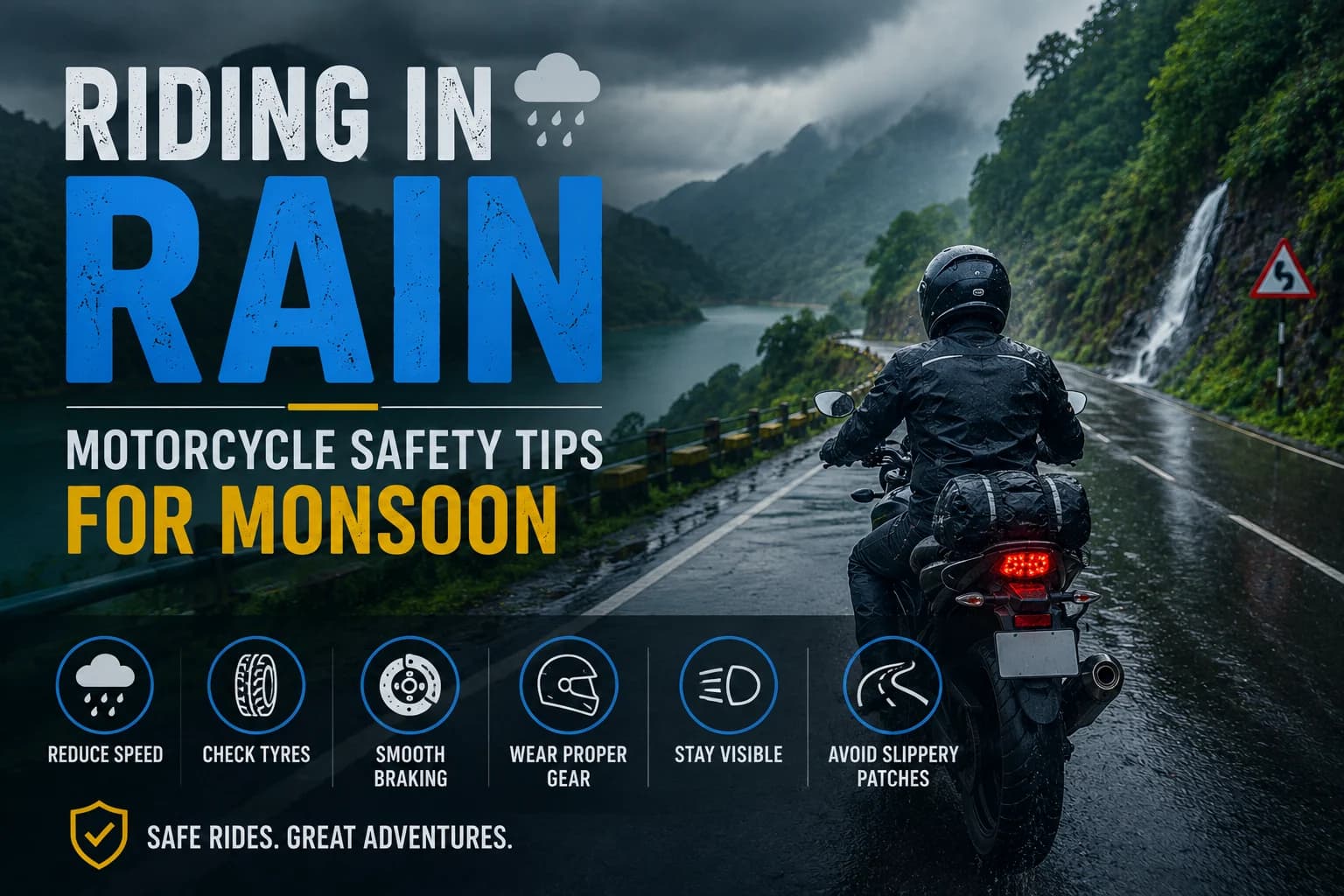
Riding in Rain: Motorcycle Safety Tips for Monsoon
Ridivo Team
·17 July 2026
Riding in Rain: Motorcycle Safety Tips for Monsoon
The first ten minutes of a monsoon downpour are the most dangerous ten minutes you'll ride all year. Oil and dust that have been sitting on the tarmac for weeks lift straight to the surface, your tyres haven't adjusted to the sudden loss of grip yet, and your visor's already starting to fog. Riding in rain isn't the same sport as riding in the dry — treat it that way and monsoon season stops being something to dread.
This guide covers motorcycle safety tips for monsoon riding, organized around the actual risks rain introduces, not just generic advice.
Table of Contents
- Quick Reference: Monsoon Riding Risks
- 1. Reduced Traction on Wet Roads
- 2. Longer Braking Distances
- 3. Poor Visibility
- 4. Slippery Road Markings and Oil Patches
- 5. Flooded Roads and Potholes
- 6. Why Waterproof Riding Gear Matters
- 7. Motorcycle Checks Before Riding in Rain
- 8. Post-Rain Maintenance
- Rain Gear Worth Investing In
- FAQs
Rain is also one of the common causes of motorcycle accidents worth understanding on its own — the risks below are the monsoon-specific version of that broader picture.
Quick Reference: Monsoon Riding Risks
| Risk | Why It's Dangerous | Quick Fix |
|---|---|---|
| Reduced traction | Wet tarmac cuts grip significantly | Smooth, gradual inputs — no sudden throttle or lean |
| Longer braking distance | Wet brakes and tyres need more distance to stop | Brake earlier, increase following distance |
| Poor visibility | Rain and fog reduce what you and others can see | Headlight on, anti-fog visor, reflective gear |
| Slippery markings & oil patches | Paint and oil film become near-frictionless when wet | Avoid riding directly over them, especially mid-corner |
| Flooded roads & potholes | Hidden depth and debris under standing water | Slow down, avoid unless depth is known, ride around edges |
| Skipping waterproof gear | Wet gear distracts and slows reaction time | Rain suit, waterproof gloves and boots before you need them |
| Skipping pre-ride checks | Worn tyres and weak brakes fail exactly when you need them | Tyre tread, pressure, brakes, chain — check before riding |
| Skipping post-rain care | Water and grit accelerate corrosion and wear | Dry, lubricate, and inspect after every wet ride |
1. Reduced Traction on Wet Roads
Wet roads cut tyre grip dramatically compared to dry tarmac, and the effect is worst in the first few minutes of rain, before the initial layer of oil and dust washes away. Reduced traction means every input — throttle, brake, lean — needs to be smoother and more gradual than usual.
- Keep tyre tread and tyre pressure in good condition; worn tread simply can't channel water away from the contact patch.
- Avoid hard acceleration or braking mid-corner — smooth inputs keep what traction you have working for you.
- Practice gentle throttle control and light engine braking to slow down rather than relying on the brakes alone.
- Widen your cornering lines slightly and reduce lean angle — this is where defensive riding techniques matter most, since there's less margin for error than in the dry.
2. Longer Braking Distances
Wet brake discs and reduced tyre grip combine to stretch your braking distance well beyond what you're used to in the dry — often by a significant margin at the same speed.
- Increase your following distance noticeably in the rain; the gap that feels safe in the dry isn't enough when it's wet.
- Brake earlier and more gradually rather than waiting until the usual braking point.
- If your motorcycle has ABS, trust it during an emergency stop rather than releasing the brake out of instinct — ABS is genuinely useful in rainy conditions and helps prevent a wheel lock that would otherwise send you into a skid.
- Favor engine braking on the approach to a stop, saving hard braking for situations that actually need it.
3. Poor Visibility
Rain reduces visibility for everyone on the road at once — your own view through a fogging visor, and other drivers' ability to spot a motorcycle through a wet windshield and blurred wipers.
- Use an anti-fog visor or treatment, and keep your helmet visor clean rather than wiping it with a wet sleeve mid-ride.
- Keep your headlight on at all times, even during the day, when rain is falling.
- Wear reflective gear where possible, especially for early morning or evening monsoon rides when light is already low.
- Increase your following distance so you have more time to react to brake lights you might otherwise catch late.
4. Slippery Road Markings and Oil Patches
Painted road markings, metal drain covers, and oil spills all become far more slippery than the surrounding tarmac once wet — often dangerously so mid-lean, where a rider has the least margin for a sudden loss of grip.
- Avoid riding directly over painted lines or metal surfaces when cornering; shift your line slightly to pass over regular tarmac instead.
- Watch for the telltale rainbow sheen of an oil patch, particularly near intersections and toll booths where vehicles idle.
- Keep the motorcycle as upright as possible when crossing any of these surfaces, even if it means a slightly wider line.
5. Flooded Roads and Potholes
Standing water hides two things at once: unknown depth and whatever's sitting underneath it — a pothole, debris, or a drop in the road surface. Riding through deep enough water can also cause hydroplaning (aquaplaning), where the tyre rides on a film of water instead of the road.
- Slow down well before any stretch of standing water, not while already in it.
- If you can't judge the depth, avoid it — ride around the edge where the water is shallower, or wait for a clearer path.
- Watch for the edges of submerged potholes, which are invisible until your front wheel drops into one.
- If you do hit standing water at speed, ease off the throttle gradually rather than braking hard, to avoid triggering a skid.
- In a group, point out flooded stretches and hidden potholes early — the same hand signals used for dry-weather hazards apply here, just with less margin for a late warning.
6. Why Waterproof Riding Gear Matters
Wet gear doesn't just mean discomfort — cold, soaked hands and feet slow your reaction time and make fine control inputs harder exactly when you need them most.
- A proper rain suit over your riding jacket keeps both you and your gear dry through a sustained downpour.
- Waterproof gloves maintain grip and dexterity on the levers, which ordinary gloves lose quickly once soaked.
- Waterproof boots keep your feet dry and your footing sure on wet pegs and slippery ground at stops.
- Pair this with the right base layer — see our guide to riding jackets for Indian weather and best riding gloves for options that hold up across seasons, not just monsoon.
7. Motorcycle Checks Before Riding in Rain
A few checks matter more in the rain than they do in the dry, since the margin for a mechanical issue is already thinner:
- Tyre tread depth and pressure — worn tyres lose disproportionately more grip once wet.
- Brake feel and pad condition — wet brakes need to be reliable from the very first application.
- Chain lubrication — rain washes away lubricant faster, increasing wear and the risk of a rough power delivery.
- Lights and indicators — visibility depends on other drivers seeing you, which starts with working lights.
- Helmet visor condition — scratches and old anti-fog coatings become a bigger problem once rain and fog combine.
Build this into your regular routine rather than a one-off before a big ride — our motorcycle maintenance checklist covers both tyre care and the rest of your pre-ride checks in more depth.
8. Post-Rain Maintenance
What happens after the ride matters almost as much as the precautions during it — water and road grit left untreated accelerate wear and corrosion.
- Dry the motorcycle down, particularly the chain, brake discs, and any exposed metal parts.
- Re-lubricate the chain once dry; monsoon riding washes lubricant away faster than normal use.
- Check the brakes for any grinding or reduced bite after a ride through standing water or grit.
- Inspect tyres for embedded stones or debris picked up from flooded or gravel-strewn stretches.
Rain Gear Worth Investing In
A few categories of gear consistently make the biggest difference for monsoon riding:
- A dedicated rain suit worn over your regular riding jacket and pants, rather than relying on the jacket's own rain resistance alone.
- Waterproof gloves, since ordinary gloves soak through quickly and cost you both grip and finger dexterity.
- Waterproof boots, which keep your footing secure at stops and junctions where wet pegs and slick ground are hardest to manage.
- An anti-fog helmet visor, since visibility loss from fogging is just as dangerous as visibility loss from rain itself.
If you're deciding on a full helmet rather than just the visor, our look at best budget helmets in India is a reasonable starting point.
FAQs
Is it safe to ride a motorcycle in the rain? Yes, with adjusted technique — slower speeds, smoother inputs, longer following distance, and proper waterproof gear. The danger comes from riding in rain the same way you'd ride in the dry.
How do you ride a motorcycle safely during monsoon? Slow down, increase following distance, avoid painted markings and oil patches, steer clear of standing water where depth is unclear, and keep your gear and motorcycle properly maintained through the season.
How can I prevent my motorcycle from skidding in rain? Keep inputs smooth — gradual throttle, gentle braking, and wider cornering lines. Sudden inputs on a wet surface are the most common trigger for a skid.
Should I reduce tyre pressure while riding in rain? Generally no — stick to the manufacturer-recommended pressure. Under-inflated tyres can actually reduce the contact patch's ability to channel water away, making things worse rather than better.
What gear is best for riding in monsoon? A dedicated rain suit, waterproof gloves and boots, and an anti-fog visor are the core pieces — all worth having before the season starts, not mid-downpour.
How should I brake on wet roads? Brake earlier and more gradually than usual, favor engine braking where possible, and trust ABS during an emergency stop rather than releasing the lever out of instinct.
Is ABS useful in rainy conditions? Yes — ABS helps prevent wheel lock during hard braking on a slippery surface, which is exactly the scenario where a locked wheel is most likely to cause a skid.
What speed is safe while riding in rain? There's no fixed number — the right speed is whatever lets you stop safely within the distance you can see ahead, which is almost always slower than your usual dry-weather pace.
Conclusion
Monsoon riding isn't something to avoid altogether — it's something to ride differently. Slow down, gear up properly, keep the motorcycle maintained through the season, and the same roads that feel risky in a downpour become manageable, even enjoyable. If you're looking for routes that are actually better in the rain, our guide to monsoon bike rides near Bangalore covers a few worth the wet ride, and pairing this with a proper motorcycle touring checklist covers you for the rest of the season.
Ride smarter with your crew
Live tracking, SOS alerts, route planning — built for Indian motorcycle and cycling groups.
Join the waitlist