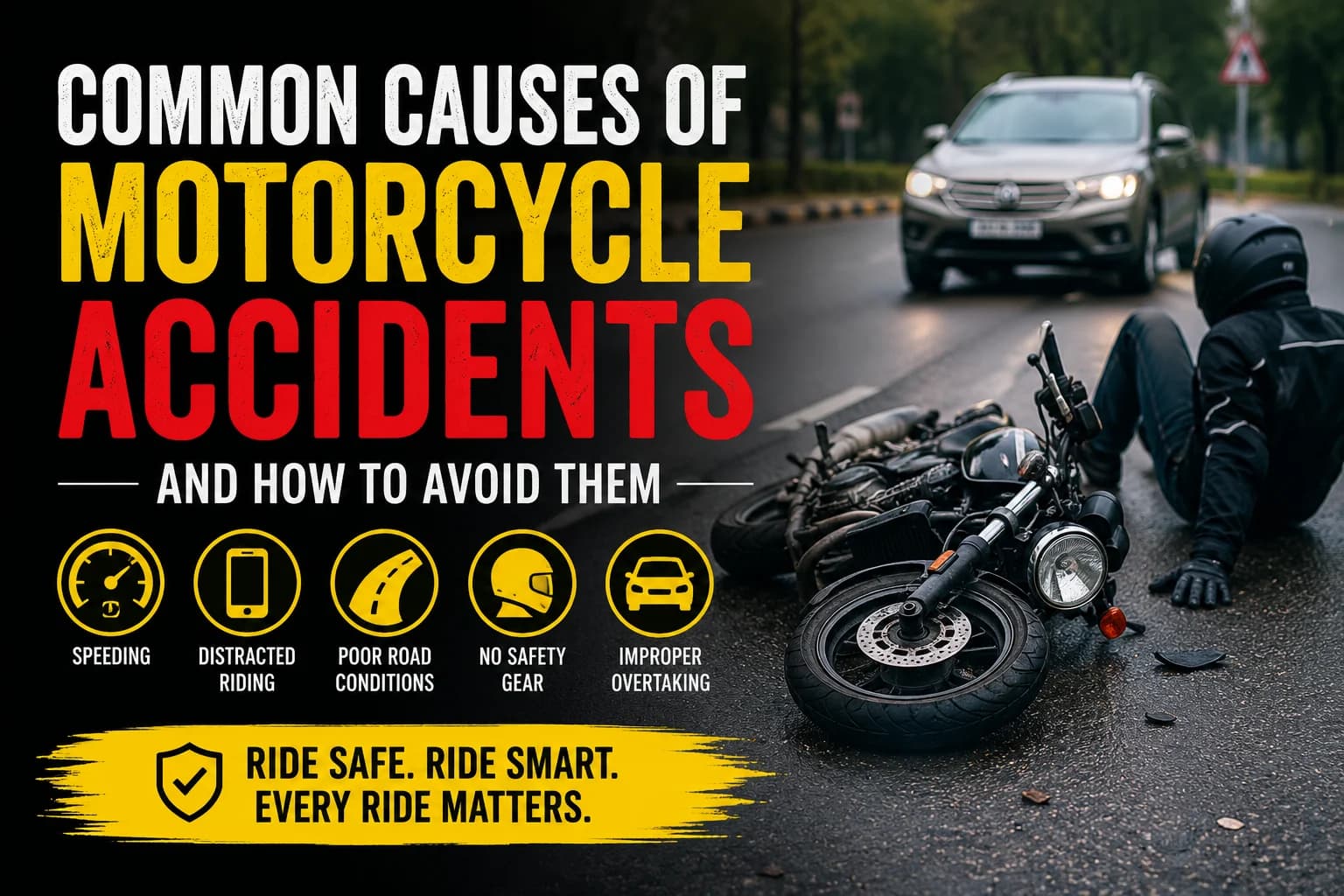
Common Causes of Motorcycle Accidents and How to Avoid Them
Ridivo Team
·17 July 2026
Common Causes of Motorcycle Accidents and How to Avoid Them
Most motorcycle accidents aren't random bad luck — they trace back to a handful of repeatable mistakes: a rider going too fast into a blind corner, a phone glance at the wrong signal, a chain that hadn't been checked in months. Understanding the common causes of motorcycle accidents is the fastest way to avoid becoming one of them.
This guide breaks down the ten most common causes, what actually goes wrong in each, and the specific habit that prevents it.
Table of Contents
- Why Understanding These Causes Matters
- Quick Reference: Causes and Fixes
- 1. Speeding
- 2. Distracted Riding
- 3. Poor Visibility
- 4. Blind Spots
- 5. Cornering Too Fast
- 6. Riding Without Protective Gear
- 7. Riding in Bad Weather
- 8. Poor Motorcycle Maintenance
- 9. Rider Fatigue
- 10. Unsafe Overtaking
- Essential Protective Gear
- Defensive Riding Techniques
- Motorcycle Safety Checklist Before Every Ride
- FAQs
Why Understanding These Causes Matters
Motorcycle riding safety isn't about riding scared — it's about defensive riding: assuming the other driver hasn't seen you, the road surface might change, and the gap you're eyeing might close faster than you think. Most of the causes below share one root problem: a rider who didn't leave themselves an out.
Quick Reference: Causes and Fixes
| Cause | Why It Happens | Quick Fix |
|---|---|---|
| Speeding | Less reaction time, longer braking distance | Match speed to road conditions, not just the limit |
| Distracted riding | Attention split between the road and a phone or thought | Phone away, mind on the ride |
| Poor visibility | Other vehicles don't see the rider in time | Bright gear, headlight on, active lane positioning |
| Blind spots | Rider or driver can't see a vehicle in the mirror's gap | Shoulder checks before every lane change |
| Cornering too fast | Traction runs out mid-corner | Slow in, look through the turn, roll on smoothly |
| Riding without protective gear | Minor accidents become major injuries | Full gear, every ride, no exceptions |
| Riding in bad weather | Reduced traction and visibility together | Slow down, increase following distance, avoid standing water |
| Poor maintenance | Worn tires, weak brakes, or a failing chain fail at the worst time | Regular checks before every ride |
| Rider fatigue | Slower reactions, poor judgment | Rest breaks, know your limits, don't push a tired ride |
| Unsafe overtaking | Misjudged gaps and blind spots collide at the worst moment | Overtake only with a clear, confirmed gap |
1. Speeding
Why it causes accidents: Speed shrinks your reaction time and stretches your braking distance at the same time — a pothole or a sudden lane change from another vehicle that's manageable at 50 km/h can be unrecoverable at 90.
How to avoid it: Ride to conditions, not just the speed limit. A clear highway and a monsoon-slicked one call for very different speeds even if the signage says the same number.
Quick safety tip: If you're not confident you could stop safely in the distance you can see ahead, you're going too fast for that stretch of road.
2. Distracted Riding
Why it causes accidents: A glance at a phone, a conversation through an intercom, or even just a wandering mind takes your eyes off changing road conditions for exactly the second a hazard appears.
How to avoid it: Treat the ride as the only task. Calls and messages wait until you're stopped — motorcycle riding demands full attention in a way a car simply doesn't.
Quick safety tip: If a thought or notification needs handling, pull over first. It's never worth the few seconds saved.
3. Poor Visibility
Why it causes accidents: Motorcycles are simply harder to see than cars — narrower profile, easy to lose in a driver's peripheral vision, especially at dusk or in rain.
How to avoid it: Keep your headlight on at all times, wear brighter gear where possible, and use lane positioning deliberately — riding where you're most visible to the vehicles around you, not just where it's most comfortable.
Quick safety tip: Assume every driver hasn't seen you yet, especially at intersections, and ride accordingly.
4. Blind Spots
Why it causes accidents: A vehicle changing lanes without checking its blind spot, or a rider not checking their own before a lane change, are two sides of the same collision.
How to avoid it: A shoulder check before every lane change is non-negotiable — mirrors alone don't cover the full blind spot on either side.
Quick safety tip: If you can't see a vehicle's mirrors, assume its driver can't see you either.
5. Cornering Too Fast
Why it causes accidents: Entering a corner faster than your line and traction allow means you either run wide or lose grip mid-turn — both usually end badly.
How to avoid it: Slow before the corner, not during it. Look through the turn toward your exit point, and use gentle counter steering combined with smooth, progressive throttle to hold your line.
Quick safety tip: Target fixation — staring at the exact hazard you're trying to avoid — often steers riders straight into it. Look where you want to go, not at what you're avoiding.
6. Riding Without Protective Gear
Why it causes accidents: This one doesn't cause the crash, but it decides how bad it gets. A slide that would leave a geared-up rider with a scare instead leaves an ungeared rider with fractures or road rash.
How to avoid it: Full gear, every single ride, regardless of distance. Most accidents happen close to home, on rides that felt too short to bother suiting up for.
Quick safety tip: If you wouldn't skip your seatbelt for a five-minute drive, don't skip your helmet for a five-minute ride.
7. Riding in Bad Weather
Why it causes accidents: Rain riding and wet roads cut traction significantly, and visibility drops for everyone on the road at the same time — a bad combination.
How to avoid it: Slow down earlier than you think you need to, increase your following distance, and actively avoid standing water, painted road markings, and metal surfaces like manhole covers, all of which get dangerously slick when wet.
Quick safety tip: ABS braking helps in a wet-weather panic stop, but it isn't a substitute for riding slower in the first place.
8. Poor Motorcycle Maintenance
Why it causes accidents: Worn tires lose traction exactly when you need it most, weak brakes extend your stopping distance without warning, and a poorly maintained chain can fail outright.
How to avoid it: Build a simple pre-ride habit — tyres, brakes, chain, lights, fluid levels — and follow it every time, not just before long trips. Our motorcycle maintenance checklist covers this in more depth.
Quick safety tip: A two-minute walkaround before you start the engine catches most maintenance-related failures before they become an accident.
9. Rider Fatigue
Why it causes accidents: Tired riders react slower, misjudge distances more often, and make worse decisions — especially on long touring stretches where the risk builds gradually.
How to avoid it: Take real rest breaks, know your own limits, and don't push through fatigue just to make good time. This matters most on longer days — the kind covered in a proper motorcycle touring checklist.
Quick safety tip: If you catch yourself losing focus on a straight, empty road, that's the moment to stop, not push on.
10. Unsafe Overtaking
Why it causes accidents: Overtaking without a confirmed clear gap combines two risks at once — misjudged distance and a blind spot you may not have checked.
How to avoid it: Only overtake when you can see the full gap is clear, factor in your own acceleration, and confirm the vehicle you're passing has actually seen you before committing. In a group, clear motorcycle hand signals before an overtake reduce the chance of a rider behind you misreading your move.
Quick safety tip: If you're not sure the gap is enough, it isn't. Wait for the next one.
Essential Protective Gear
Protective gear doesn't prevent accidents, but it decides the outcome when one happens:
- Full-face helmet — the single most important piece of safety equipment on this list; see our helmet buying guide for how to choose one properly.
- Riding jacket — with CE-certified armour at the shoulders and elbows; our guide to riding jackets for Indian weather covers options across seasons.
- Riding gloves — protect hands first in almost every fall; see our best riding gloves roundup for picks across budgets.
- Riding boots — ankle protection that sneakers simply don't offer.
- Knee guards — often skipped, but knees take direct impact in many low-speed falls.
- CE-certified armour — the actual proof of protection, not just padding that looks protective.
- ABS (Anti-lock Braking System) — helps maintain control during emergency braking, particularly valuable on wet or gravel-covered roads.
Defensive Riding Techniques
A few core techniques reduce risk across almost every cause above:
- Following distance — a longer gap gives you more time to react to whatever the vehicle ahead does.
- Lane positioning — riding in the part of the lane where you're most visible and have the most escape room, not just the most comfortable position.
- Emergency braking — practicing a firm, controlled stop somewhere safe means it's muscle memory, not a first attempt, when you actually need it.
- Counter steering — understanding how a motorcycle actually turns at speed (press the bar in the direction you want to lean) makes cornering and quick avoidance manoeuvres far more predictable.
- Traffic awareness — constantly scanning for the next hazard rather than reacting only once something happens.
- Rider training — a proper riding course teaches these techniques under supervision, which is worth far more than picking them up by trial and error on the road.
If you're newer to riding, practicing these on quieter, low-traffic roads first is worth the extra time — our beginner-friendly bike rides near Bangalore list is a reasonable place to build confidence before tackling busier routes.
Motorcycle Safety Checklist Before Every Ride
- Gear on — helmet, jacket, gloves, boots, every time.
- Quick walkaround — tyres, brakes, chain, lights, fuel.
- Weather check — know what you're riding into before you leave.
- Route awareness — rough idea of road conditions and fuel stops ahead.
- Physical state check — rested, hydrated, and not riding through fatigue.
New riders especially benefit from pairing this with a look at common and, if riding with others, a proper group riding safety guide covering formation and communication.
FAQs
What is the most common cause of motorcycle accidents? Speeding and unsafe overtaking are consistently among the leading causes — both remove the margin a rider needs to react to a sudden hazard.
How can motorcycle accidents be prevented? Through a combination of defensive riding habits, full protective gear, regular maintenance, and riding within your own limits and the road's actual conditions rather than the posted speed limit alone.
Are motorcycles more dangerous than cars? Motorcycles offer less physical protection in a collision, which is why gear and defensive riding technique matter more — the margin for error is smaller than in a car.
How important is wearing a helmet? Critical. A full-face helmet is the single biggest factor in surviving a serious head impact, and most fatal motorcycle accidents involve head injuries that proper helmet use could have prevented or reduced.
How does speeding increase motorcycle accidents? It reduces reaction time and increases braking distance simultaneously, turning manageable hazards — a pothole, a sudden lane change — into unavoidable ones.
What should riders do in wet weather? Slow down earlier than usual, increase following distance, avoid painted lines and manhole covers, and ride more cautiously through corners where traction is already reduced.
How can beginners reduce accident risk? Start on quieter roads, avoid group rides until comfortable with the basics, invest in proper gear immediately, and consider formal rider training rather than learning defensive techniques through trial and error.
What safety gear should every rider wear? At minimum: a full-face helmet, a riding jacket with CE-certified armour, riding gloves, and proper riding boots. Knee guards are a strong addition for extra protection.
Conclusion
Nearly every motorcycle accident on this list traces back to a decision that could have gone differently — a speed choice, a skipped gear check, a gap that wasn't actually clear. Ride defensively, gear up every time, and treat maintenance as part of the ride, not an afterthought.
Ride smarter with your crew
Live tracking, SOS alerts, route planning — built for Indian motorcycle and cycling groups.
Join the waitlist