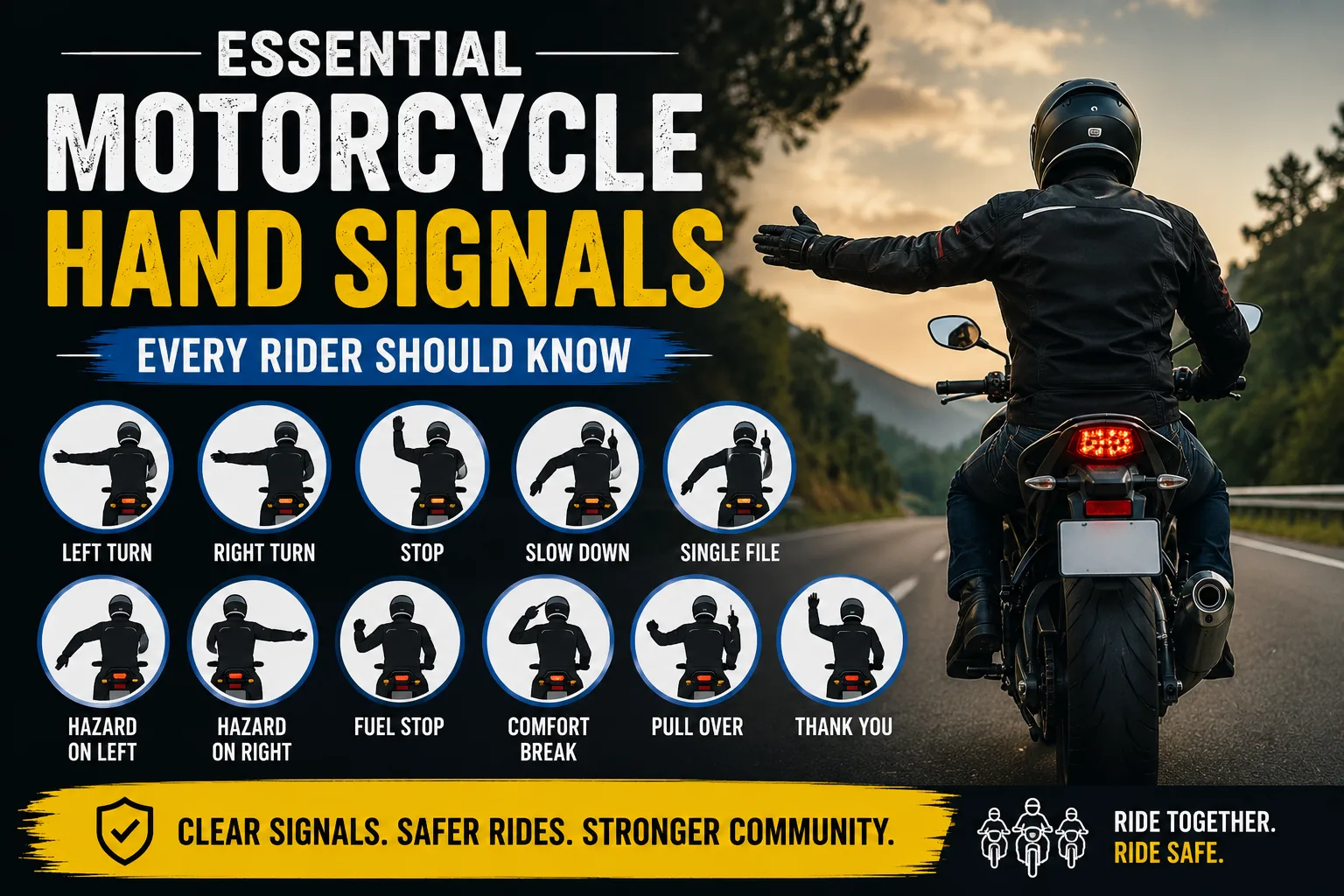
Essential Motorcycle Hand Signals Every Rider Should Know
Ridivo Team
·17 July 2026
Essential Motorcycle Hand Signals Every Rider Should Know
Your indicator clicks are useless to the rider behind you once you're doing 80 on the highway with your visor down. That's what motorcycle hand signals are actually for — a shared language between helmets when a horn or a shout won't carry. Every experienced group rider knows a handful of these on instinct; every beginner has to learn them the hard way, usually by missing one.
This guide covers the essential motorcycle hand signals every rider should know, how to perform each one, and where riders commonly get them wrong.
Table of Contents
- Why Hand Signals Matter
- Quick Reference: Motorcycle Hand Signals
- The Essential Motorcycle Hand Signals
- Hand Signals Vary by Group and Region
- Rider Etiquette for Using Hand Signals
- Common Mistakes Riders Make
- FAQs
Why Hand Signals Matter
Rider communication doesn't stop at the helmet intercom — plenty of riders don't have one, and even the ones who do lose signal in traffic or on a long stretch of highway. Hand signals fill that gap: pointing out road hazards, calling a fuel stop, or warning the rider behind you about a pothole before their front wheel finds it.
They matter most in formation riding, where a staggered formation or a single file line depends on everyone reacting to the same signal at roughly the same moment. If you're riding with a group regularly, this pairs well with a full group riding safety guide covering formation, spacing, and lead/sweep roles — hand signals are really just the vocabulary that makes all of that work.
Quick Reference: Motorcycle Hand Signals
| Signal | How to Perform | Meaning |
|---|---|---|
| Left turn | Left arm out, straight | Turning or moving left |
| Right turn | Left arm out, bent up at elbow | Turning or moving right |
| Stop | Left arm out, bent down, palm back | Stop immediately |
| Slow down | Left arm out and down, palm patting the air | Reduce speed |
| Single file | Left arm up, one finger pointing up | Form a single-file line |
| Hazard on left | Left arm pointing down-left | Obstacle on the left side |
| Hazard on right | Right foot pointing down, or left hand across body pointing right | Obstacle on the right side |
| Fuel stop | Left arm out, hand tapping the top of the helmet or fuel tank gesture | Need to refuel soon |
| Comfort break | Left fist tapping the seat | Need a rest stop |
| Helmet tap | Tapping the top of the helmet | Attention needed — meaning varies by group |
| Pull over | Left arm extended, waving down toward the ground | Group should stop riding |
| Thank you | A raised hand, foot tap, or nod to another rider or driver | Acknowledgement or courtesy |
The Essential Motorcycle Hand Signals
1. Left Turn
How to perform: Extend your left arm straight out to the side, parallel to the ground.
What it means: You are turning or moving left.
When to use it: Before every left turn or lane shift, ideally well before you actually move.
Common mistake: Signaling at the same moment you turn instead of a few seconds ahead, leaving the rider behind no time to react.
2. Right Turn
How to perform: Extend your left arm out and bend it upward at the elbow, forearm pointing skyward.
What it means: You are turning or moving right.
When to use it: Before a right turn, right lane shift, or overtaking on the right.
Common mistake: Confusing this with the "slow down" signal, since both start from the same extended-arm position.
3. Stop
How to perform: Extend your left arm out and bend it downward at the elbow, palm facing behind you.
What it means: Stop immediately — something ahead requires the group to halt.
When to use it: Sudden hazards, a wrong turn, or a checkpoint the group needs to stop at.
Common mistake: Using it interchangeably with "slow down," which causes confusion about whether to brake hard or just ease off.
4. Slow Down
How to perform: Extend your left arm down and slightly out, palm facing down, patting the air a few times.
What it means: Reduce speed — no need to stop, just ease off.
When to use it: Approaching a speed breaker, a sharp curve, loose gravel, or slower traffic ahead.
Common mistake: A single flat wave that looks identical to a casual gesture rather than a deliberate patting motion, so the rider behind misses it entirely.
5. Single File
How to perform: Raise your left arm straight up, index finger pointing to the sky.
What it means: The group should move from a staggered formation into a single file line.
When to use it: Narrowing roads, oncoming traffic, or entering a construction zone.
Common mistake: Giving this signal too late, right at the narrow stretch instead of well before it.
6. Hazard on Left
How to perform: Point your left arm down and to the left, indicating the ground.
What it means: There's a pothole, debris, or obstacle on the left side of the lane.
When to use it: The moment you spot the hazard, so the group behind has time to shift right.
Common mistake: Pointing after you've already swerved around it, which gives zero warning to the rider right behind you.
7. Hazard on Right
How to perform: Extend your right foot downward, or bring your left hand across your body pointing right.
What it means: There's an obstacle on the right side of the lane.
When to use it: Same as hazard-left, but mirrored — the earlier the better.
Common mistake: Only using the foot signal, which is harder for riders further back to see than a raised arm.
8. Fuel Stop
How to perform: Extend your left arm out and tap the top of your helmet, or point toward your fuel tank.
What it means: You (or the group) need to stop for fuel soon.
When to use it: When you notice your tank running low, well before the next known fuel stop.
Common mistake: Waiting until the tank is nearly empty to signal, leaving no buffer if the next pump is further than expected.
9. Comfort Break / Rest Stop
How to perform: Tap your left fist against your seat a few times.
What it means: You need a short rest or bio break.
When to use it: On longer touring stretches, ideally near an upcoming known stop rather than mid-highway.
Common mistake: Not signaling at all and just slowing down or drifting out of formation, which reads as a mechanical problem rather than a simple break request.
10. Helmet Tap
How to perform: A firm tap on the top of your own helmet.
What it means: This one genuinely varies — depending on the group and region, a helmet tap can mean "hazard ahead," "police checkpoint," or simply "pay attention." Some riders use it as a general alert rather than anything specific.
When to use it: Whenever you need to flag something important but don't have a more specific signal for it.
Common mistake: Assuming every group interprets this the same way. Confirm what your group means by it before you ride, rather than assuming.
11. Pull Over
How to perform: Extend your left arm out and wave it downward toward the ground in a sweeping motion.
What it means: The group should pull over and stop riding.
When to use it: A breakdown, an injury, a wrong turn that needs sorting out, or any situation that needs the whole group off the road.
Common mistake: A weak, low-amplitude wave that gets missed in a rider's peripheral vision — this signal needs a full, deliberate sweep to register.
12. Thank You / Appreciation
How to perform: A raised hand, a foot tap, or a small nod toward another rider or a driver who gave way.
What it means: Acknowledgement — thanks for the courtesy.
When to use it: When another vehicle lets you through, or another rider does something helpful on the road.
Common mistake: Skipping it entirely. It costs nothing and it's a big part of rider etiquette that keeps roads friendlier for the next biker.
Hand Signals Vary by Group and Region
Not every group uses identical signals, and that's fine as long as everyone in your group agrees beforehand. The helmet tap is the clearest example — one group's "police ahead" is another group's general "heads up." Before a long ride, especially with riders you haven't toured with before, spend two minutes confirming what each signal means to this specific group. It's a small conversation that prevents a real miscommunication later.
Rider Etiquette for Using Hand Signals
- Signal early, not at the last second — the rider behind you needs reaction time, not just information.
- Keep formation riding rules in mind: in a staggered formation, hazards need to be visible past the rider ahead, so exaggerate the signal slightly if you're not sure it's been seen.
- Confirm a hazard signal has been passed down the line, especially on longer touring convoys where the group stretches out.
- Pointing out hazards is a shared responsibility — don't assume the lead rider will catch everything; every rider should relay what they see.
- Riding gear affects how visible your signals are. A dark riding jacket at dusk makes an arm signal harder to spot, and bulky riding gloves can make finer gestures like the single-file point less crisp — factor that into how deliberate you make each signal.
Common Mistakes Riders Make
- Signaling too late. A signal given at the exact moment of the action defeats the purpose — the whole point is advance warning.
- Inconsistent gestures. Vague waves that could mean several things force the rider behind to guess.
- Assuming everyone already knows the signals. Beginners on their first group ride often don't, and won't ask unless someone offers to walk through them first.
- Not relaying signals down a long convoy. In a big group, a hazard signal from the front is only useful if it's passed rider to rider, not just given once.
- Treating hand signals as optional gear knowledge. They belong in the same category as your essential motorcycle riding gear checklist — not an afterthought, a basic that should be reviewed before every group ride, similar to how you'd review a motorcycle touring checklist or the common motorcycle touring mistakes worth avoiding.
FAQs
Are motorcycle hand signals universal in India? Mostly, yes, for the core ones — left turn, right turn, stop, slow down, and hazard pointing are widely recognized. Signals like the helmet tap vary more by group and region, so it's worth confirming meanings before a ride with new riders.
What is the most important hand signal for beginners to learn first? Hazard pointing (left and right) and the slow-down signal matter most early on — they directly prevent accidents, more than turn signals which riders usually pick up naturally.
Do hand signals replace indicators? No. Indicators handle the vehicles around you; hand signals are for the riders in your own group who need earlier or more specific warning than an indicator light gives.
How do I introduce hand signals to a new group of riders? Spend a few minutes before rolling out — a quick walkthrough of the core signals your group uses, especially the helmet tap, avoids confusion once you're on the road and can't easily talk it through.
Are hand signals necessary for solo riders? Less critical solo, but still useful — acknowledging other riders with a thank-you signal, or communicating with a passing group, is part of general rider etiquette on shared roads.
Conclusion
Hand signals are one of the cheapest safety upgrades a group of riders can make — no gear to buy, just a shared understanding built before you roll out. If you're new to riding with a group, a short, low-traffic route is the best place to practice them — our beginner-friendly bike rides near Bangalore list is a good place to start. And if your group ever gets separated despite the best signals, Ridivo's live location sharing means you're never actually relying on hand signals alone to find each other again.
Ride smarter with your crew
Live tracking, SOS alerts, route planning — built for Indian motorcycle and cycling groups.
Join the waitlist