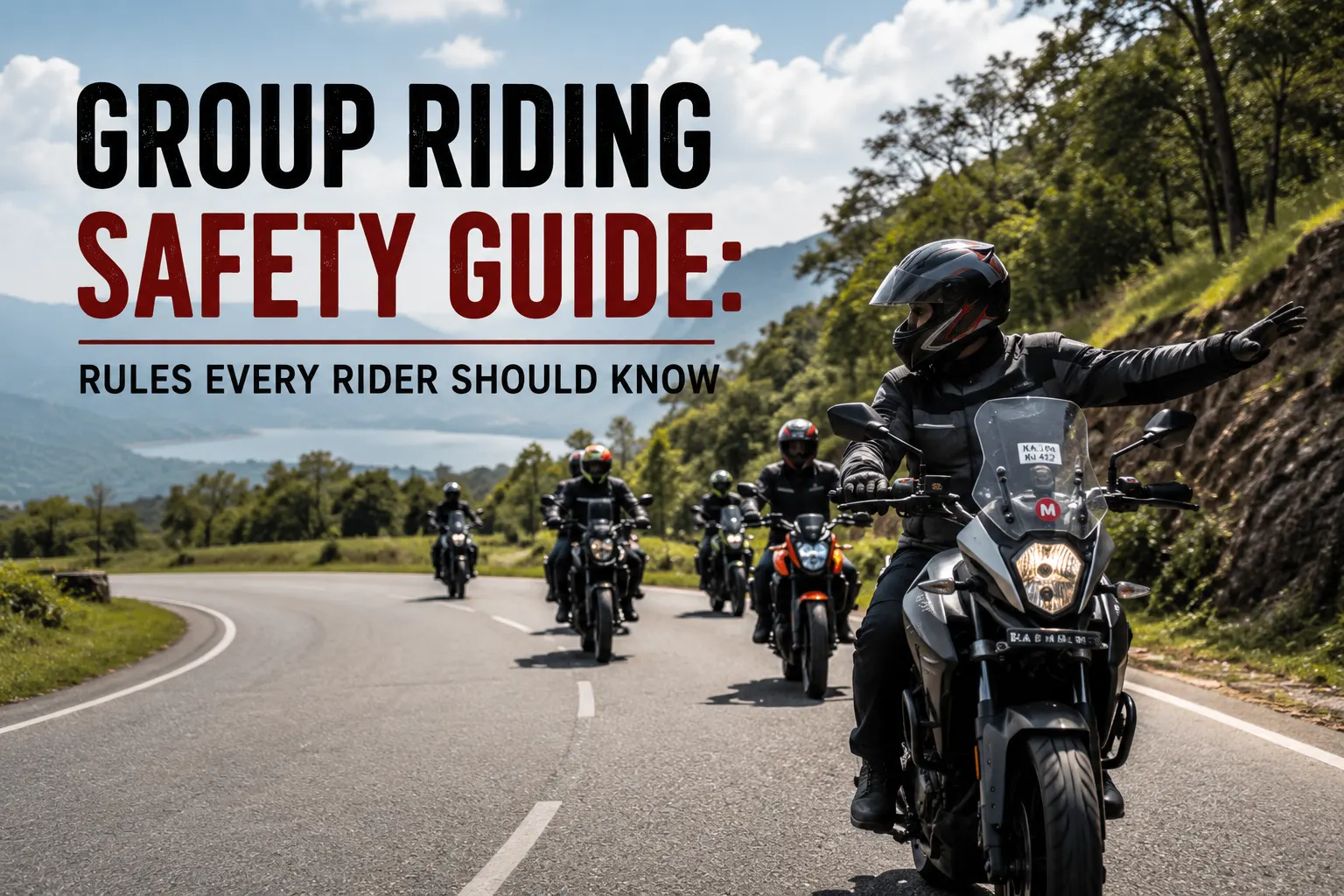
Group Riding Safety Guide: Rules Every Rider Should Know
Ridivo Team
·20 June 2026
Group Riding Safety Guide: Rules Every Rider Should Know
Twelve bikes idle at a fuel station on the edge of town, engines ticking, riders pulling on gloves. Someone raises a fist, the line goes quiet, and a minute later the whole group rolls out as one — staggered, spaced, and moving like it has done this a hundred times. That's not luck. That's group riding etiquette, and it's the difference between a ride that flows and one that scatters at the first signal.
Riding in a group is one of the best parts of motorcycling. It's also where small mistakes multiply. This guide covers the rules that keep group bike rides safe, smooth, and fun — for the lead rider and the nervous first-timer alike.
Table of contents
- Why group riding etiquette matters
- Staggered formation
- Hand signals every rider should know
- Communication
- Ride leader roles
- Speed discipline
- Emergency protocols
- Fuel stop etiquette
- Tips for beginner riders
- FAQ
Why group riding etiquette matters
A group moves only as safely as its least-prepared rider. When everyone follows the same rules — spacing, signals, speed — the group becomes predictable, and predictable is safe. When they don't, you get sudden braking, surprise overtakes, and riders left behind at junctions.
Good etiquette isn't about being rigid. It's a shared language that lets a dozen strangers ride like a team.
Staggered formation
Staggered formation is the backbone of safe group riding. Riders alternate left and right within the lane instead of riding side by side or in a single tight line.
Featured-snippet target — what is staggered formation: Staggered formation is a group riding pattern where the lead rider takes one side of the lane, the next rider takes the other side, and so on down the line. Each rider keeps roughly a two-second gap to the rider directly ahead and one second to the one beside them. It gives everyone space to brake and a clear escape path.
Why it works:
- It doubles your following distance without stretching the group too far apart.
- It gives each rider room to swerve if something appears in the road.
- It keeps the group compact enough to stay together through traffic.
On tight twisties and ghats, the group should drop into single file with extra spacing — staggered formation is for open, straight roads.
Hand signals every rider should know
When you can't hear each other over engines and wind, hands do the talking. Every rider in the group should know these before rolling out.
- Left turn: left arm straight out.
- Right turn: left arm out, bent up at 90 degrees (or right arm straight out).
- Slow down: left arm out, palm down, patting the air.
- Stop: left arm down, palm facing back.
- Hazard on the road: point at it — foot or hand toward the pothole, gravel, or obstacle.
- Fuel stop: point at the tank.
- Single file: one finger raised straight up.
- Follow me / regroup: arm up, swung forward.
Tip: Run through the signals at the start-of-ride briefing. Two minutes in the parking lot saves a lot of confusion at 60 km/h.
Communication
Hand signals cover the basics, but longer rides need a fuller plan. Before the group rolls out, agree on the route, the pitstops, and the regroup points.
This is where coordination tools earn their place. Ridivo lets the group build a ride with waypoints and pitstops, share live GPS so every rider sees each other on the map, and keep an in-ride chat for quick calls — so when the group splits at a signal, nobody's guessing where the front went. Assigning roles like captain and sweep inside the app means everyone knows their job before the engines start.
Ride smarter with your crew
Live tracking, SOS alerts, route planning — built for Indian motorcycle and cycling groups.
Join the waitlistRide leader roles
Every organised group ride needs clear roles. Three matter most:
The captain (lead). Knows the route, sets the pace, and makes the calls. The captain rides for the group, not for themselves — smooth, predictable, and never faster than the slowest rider can safely manage.
The sweep (tail). Rides at the very back and makes sure no one is left behind. If a rider drops off, the sweep stays with them. The group ahead doesn't leave until the sweep confirms everyone's accounted for.
The medic / mechanic. On longer community bike rides, it helps to know which rider carries a first-aid kit and which one can handle a roadside repair. Assign it openly so everyone knows who to look for.
The golden rule of formation: the captain leads, the sweep closes, and no one overtakes the captain or falls behind the sweep.
Speed discipline
Speed is where group rides most often go wrong. The temptation to keep up with a faster rider pulls beginners into corners they can't read.
- Ride your own ride. The group regroups at the next stop. Never chase a pace that scares you.
- No racing, no surprise overtakes. Sudden moves inside a group are how chain reactions start.
- Use the rubber-band rule. The front holds back slightly so the back can catch up. The pace is set by the group, not the fastest bike.
- Pace for the slowest safe rider, not the quickest one.
A disciplined group rides at one steady speed. That predictability is what makes riding safety in a pack actually work.
Emergency protocols
Even a well-run ride can hit a problem — a breakdown, a fall, a sudden hazard. Agree on what happens before it does.
- If a rider goes down or stops, the sweep stays with them; the rest pull over safely ahead and wait.
- Don't crowd the road at an incident. Park well off the carriageway and switch on hazards.
- Know your group's emergency contacts and the nearest town with a hospital on long routes.
Ridivo's skill-aware SOS fits here: an emergency alert goes to the nearest riders chosen by skill — first aid or bike repair — and texts your emergency contacts, so help routes to the person best able to give it instead of a blind shout into the group.
Fuel stop etiquette
Fuel stops are where a group either stays tight or falls apart. A little etiquette keeps them quick and painless.
- Pull in together and fuel as a group so you all leave together.
- Move bikes clear of the pump once fuelled — don't block the next rider.
- Use the stop to regroup: hydrate, confirm everyone's fine, and brief the next leg.
- Wait for the sweep before rolling out. Leaving a rider mid-fuel is the fastest way to lose them.
- Top up early. Fuel at the last big town before any ghat or forest stretch, not after.
A good captain treats every fuel stop as a mini head-count. Twelve out, twelve back on the road.
Tips for beginner riders
New to group bike rides? You belong here — just ride smart and speak up.
- Tell the group you're new. A good group will put you in front of the sweep and keep an eye on you.
- Hold your line and your position. Don't drift across the lane or close gaps suddenly.
- Don't fixate on the bike ahead. Look through the group and up the road.
- Ask about the signals and the regroup plan before you roll out. No one minds the question.
- Speak up if the pace is too much. A safe group would always rather slow down than lose you.
Joining a community of riders is one of the best ways to improve. Find a group that briefs properly, rides patiently, and looks after its tail — that's the kind of bike ride group worth sticking with.
FAQ
What is the most important rule of group riding? Ride your own ride. The group regroups at the next stop, so never chase a pace you can't handle. Combined with staggered formation and a clear sweep rider, it's what keeps group bike rides safe.
What is staggered formation and why use it? It's a pattern where riders alternate sides of the lane rather than riding side by side. It doubles your following distance, gives each rider an escape path, and keeps the group compact enough to stay together in traffic.
How big should a group ride be? Smaller groups (up to about 8–10 bikes) are easiest to keep together and safe. Larger groups should split into sub-groups, each with its own captain and sweep, with regroup points along the way.
What roles should a group ride have? At minimum a captain up front who sets the route and pace, and a sweep at the back who makes sure no one's left behind. On longer rides, also know who carries first aid and who can manage a roadside repair.
I'm a beginner — is it safe to join a group ride? Yes, with the right group. Tell them you're new, ride just ahead of the sweep, learn the hand signals at the briefing, and never push past a comfortable pace. A good group rides for its slowest safe rider.
How do hand signals work on a group ride? The lead rider gives a signal and each rider passes it down the line, so the message travels from front to back. Agree on the signals before the ride so everyone reads them the same way.
Ride smarter with your crew
Live tracking, SOS alerts, route planning — built for Indian motorcycle and cycling groups.
Join the waitlist