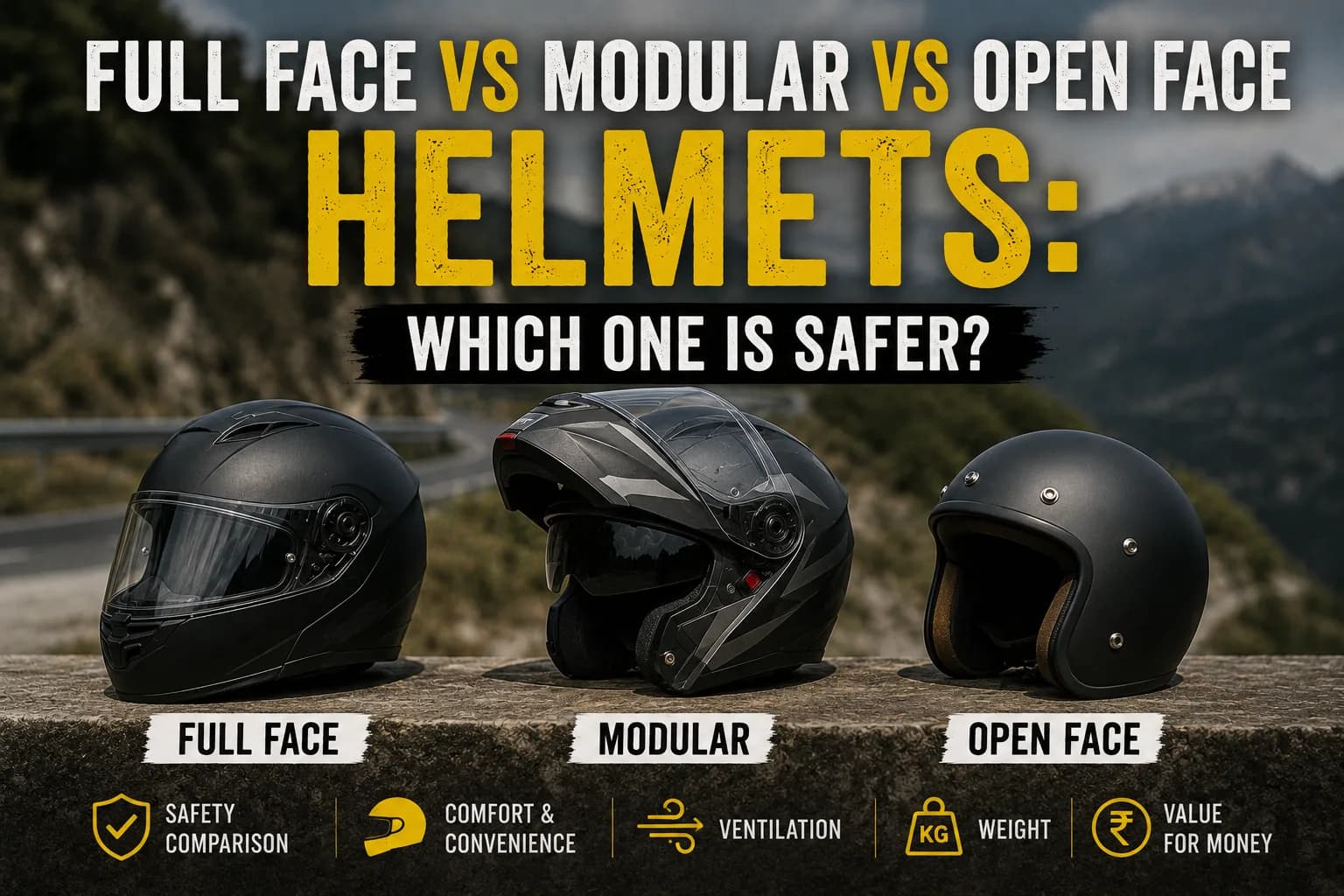
Full Face vs Modular vs Open Face Helmets: Which One Is Safer?
Ridivo Team
·20 June 2026
Full Face vs Modular vs Open Face Helmets: Which One Is Safer?
It's the oldest debate in any rider group: full face for the protection, modular for the convenience, or open face for the freedom. Line all three up on a shelf and they look like variations on a theme — but in a crash, the differences between them are anything but cosmetic.
This guide settles the full face vs modular vs open face question across the things that actually matter — safety, comfort, noise, and ventilation — and tells you which type suits which kind of rider. If you already know you want a full face, our buying guide covers how to pick one; this is about choosing the type first.
Table of contents
- Helmet types overview
- Safety comparison
- Touring comfort
- Noise levels
- Ventilation
- City riding vs touring
- Pros and cons at a glance
- Best use cases
- Recommendations by rider type
- FAQ
- Conclusion
Helmet types overview
Three shapes, three philosophies:
- Full face — a single solid shell with a fixed chin bar that wraps your entire head and face. The most complete coverage of the three.
- Modular (flip-up) — looks like a full face, but the chin bar and visor hinge upward so you can open the front at a stop. A compromise between protection and convenience.
- Open face (3/4) — covers the top, back, and sides of your head but leaves your face and chin exposed. The most airy and the least protective.
The trade-off runs in a straight line: the more of your face a helmet covers, the more it protects, and the less airy and convenient it tends to be.
Safety comparison
This is the heart of the question. On pure protection, the order is clear.
Featured-snippet target — which helmet type is safest? The full face helmet is the safest type, because it's the only one with a fixed chin bar protecting your jaw and face — and a large share of motorcycle impacts land on the chin area. A modular helmet is a close second when closed and properly certified, while an open face helmet offers the least protection because it leaves the face and chin exposed.
The detail behind that:
- Full face protects the chin and face with a fixed, structurally solid bar — the area open-face designs leave completely unguarded.
- Modular matches a full face closely when closed, but the hinge is a slight structural compromise. Look for one with dual P/J certification under ECE, meaning it's approved as protective both closed (P) and open (J) — a genuinely well-engineered modular.
- Open face offers solid coverage to the skull but nothing for your chin and face, so it's the weakest of the three in a frontal impact.
Whichever type you choose, the certification matters as much as the shape — see our Motorcycle Helmet Guide for ISI and ECE 22.06 details.
Touring comfort
Over a long day in the saddle, comfort is a safety feature — a comfortable rider stays alert.
- Full face: excellent wind and weather protection at speed, quiet, and stable. The long-haul standard.
- Modular: the touring favourite for convenience — flip up at a toll, a fuel stop, or for a quick drink without removing the helmet. Slightly heavier, which can tell over a very long day.
- Open face: breezy and unrestrictive at low speed, but tiring at highway speed as wind buffets your face and neck.
For long-distance motorcycle touring gear, a full face or a good modular wins comfortably.
Noise levels
Wind noise causes fatigue and long-term hearing damage, and it varies a lot by type.
- Full face: the quietest, thanks to a fully sealed shell.
- Modular: quiet when closed, but the hinge and seams usually let in a little more noise than a full face.
- Open face: the loudest by far, with your ears fully exposed to wind blast.
On any type, earplugs are worth carrying for long highway days — but if quiet matters to you, a full face is the natural pick.
Ventilation
The flip side of coverage: more airflow, less protection.
- Open face: the coolest by a wide margin — ideal for hot, slow city riding.
- Modular: good airflow, with the option to flip up at a stop for instant relief.
- Full face: depends entirely on the vent design; a well-vented full face is comfortable even in Indian heat, but a poorly vented one can feel stuffy in traffic.
In stop-go city heat, open and modular helmets have the edge; at speed, a vented full face breathes perfectly well.
City riding vs touring
The honest split for most riders:
- City / commuting: short, low-speed trips where heat and convenience matter most. Open face and modular helmets shine here.
- Touring / highway: long, fast rides where protection, quiet, and wind management matter most. Full face and modular helmets are the right tools.
If you do both, buy for the harder job — a full face or modular handles the city fine, but a basic open face won't keep you protected or comfortable on a 250 km highway day.
Pros and cons at a glance
| Type | Protection | Comfort (touring) | Noise | Ventilation | Best for |
|---|---|---|---|---|---|
| Full face | Highest | Excellent | Quietest | Vent-dependent | Touring, highway, all-round safety |
| Modular | High (closed) | Very good | Low–moderate | Good | Tourers wanting convenience |
| Open face | Lowest | Fair | Loudest | Best | Short, slow city rides |
Best use cases
- Full face: highway riding, touring, fast roads, year-round all-rounder, and anyone for whom protection is the top priority.
- Modular: long-distance tourers, riders who wear glasses, and those who like to flip up at stops without taking the helmet off.
- Open face: scooter and short-commute riders in heavy city heat who accept the protection trade-off for airflow and visibility.
Recommendations by rider type
- New rider / commuter: a well-fitted full face gives you the most protection while you build experience. If you ride only short, slow city trips and prioritise airflow, a quality open face is acceptable — but understand the trade-off.
- Weekend / highway rider: a full face is the straightforward best choice for speed, quiet, and protection.
- Long-distance tourer: a full face for maximum protection and quiet, or a dual-certified modular if you value the flip-up convenience on long days. Pair it with the rest of your kit from our Riding Gear Guide.
- Group rider: any well-certified full face or modular — and since group riding adds its own coordination needs, Ridivo helps the whole group stay together with live location and a skill-aware SOS that routes an emergency alert to the nearest rider who can help. See our Group Riding Safety Guide for the full set of rules.
Ride smarter with your crew
Live tracking, SOS alerts, route planning — built for Indian motorcycle and cycling groups.
Join the waitlistFAQ
Which is safer, a full face or a modular helmet? A full face is marginally safer because its chin bar is fixed and structurally solid, while a modular's hinge is a slight compromise. A properly certified modular (with dual P/J approval) is very close and perfectly safe for touring — the gap is small but real.
Is an open face helmet safe enough? An open face protects your skull but leaves your face and chin exposed, so it's the least protective type in a frontal crash. It's a reasonable choice only for short, low-speed city riding where you accept that trade-off — not for highway or touring use.
Are modular helmets good for touring? Yes — modular helmets are a touring favourite. The flip-up front is genuinely convenient at tolls, fuel stops, and for riders who wear glasses. Choose a dual-certified model and you give up very little protection for that convenience.
Which helmet type is quietest? The full face is the quietest because it's a fully sealed shell. Modular helmets are close when closed, and open face helmets are the loudest. On any type, earplugs help on long highway rides.
What helmet should a beginner buy? For most beginners, a well-fitted full face offers the best protection while you gain experience. If your riding is strictly short, slow, and city-bound and you want airflow, a quality certified open face is an option — just understand it protects less.
Conclusion
In the full face vs modular vs open face debate, the safety answer is simple: full face leads, a good modular follows close behind, and open face trades protection for airflow. The right pick is the one that matches your riding — a full face for touring and highway speed, a modular for tourers who want convenience, and an open face only for short, slow city hops. Choose the type for your riding, get it certified and fitted properly, and your most important piece of gear will do its job.
Ride smarter with your crew
Live tracking, SOS alerts, route planning — built for Indian motorcycle and cycling groups.
Join the waitlist